With the global mass spectrometry market projected to grow from $6.6 billion in 2025 to $9.3 billion by 2030—a 7.2% CAGR driven by pharmaceutical R&D, environmental PFAS monitoring, and clinical diagnostics expansion—laboratories are investing in complete analytical environments, not just instruments. The bench selection decision has never carried higher stakes.
Key Takeaways
- Purpose-built MS benches protect turbomolecular pumps, isolate vacuum pump vibration, and keep LC/GC/MS workflows organized
- The wrong bench degrades equipment, skews measurements, and can create compliance gaps
- Top 5 manufacturers: Workplace Modular Systems, ionBench, Kewaunee Scientific, IAC Industries, and BenchPro
- Key selection criteria: 300+ kg load capacity, vibration isolation, noise enclosures, modularity, and OEM compatibility
- US-made benches offer shorter lead times and simpler reconfiguration as lab needs change
What Is a Mass Spectrometry Bench (and Why It Matters)
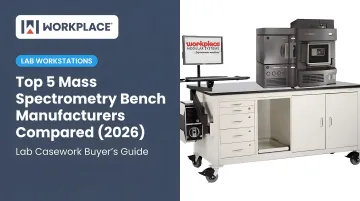
A mass spectrometry bench is a specialized laboratory workstation engineered to support the unique operational demands of LC-MS, GC-MS, ICP-MS, and hybrid MS configurations. Unlike general-purpose lab furniture, these benches address three critical requirements:
Load-bearing capacity: Thermo Fisher's Orbitrap Exploris series alone weighs 120 kg (265 lb); with LC modules, forepumps, and data stations added, total system load can exceed 300 kg (660+ lb). Agilent's 6400 Series Triple Quad systems reach 150 kg before the HPLC stack is included. Standard lab furniture isn't built to handle these loads safely.
Vibration isolation: Rotary vane forepumps transmit continuous mechanical vibration through the bench surface to the MS chassis, degrading turbomolecular pump bearings and introducing baseline noise. Agilent's site preparation checklists require supporting surfaces be "relatively vibration free" for optimum mass accuracy.
Peripheral integration: A complete LC-MS setup involves solvent bottles, nitrogen lines, waste containers, data systems, and electrical distribution — all competing for the same limited bench space. Purpose-built benches handle this with integrated cable raceways, tubing cutouts, and accessory mounting points that keep the deck clear and the workflow moving.
The operational risks of using standard lab furniture include:
- Shortened turbomolecular pump service intervals and increased maintenance costs
- Compromised spectral resolution from vibration-induced baseline drift
- Safety hazards from inadequate load support
- Workflow inefficiencies in high-throughput environments
- Compliance failures in regulated pharmaceutical and clinical labs
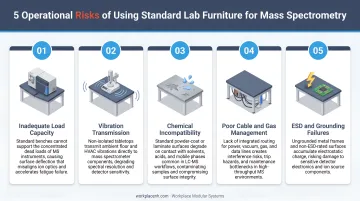
Choosing the wrong bench doesn't just create inconvenience — it accelerates instrument wear, inflates maintenance budgets, and can trigger compliance findings in regulated labs. The five manufacturers compared below each address these demands differently.
Top 5 Mass Spectrometry Bench Manufacturers (2026)
These manufacturers were evaluated based on engineering capability for analytical environments, documented load ratings, vibration/noise management provisions, MS-specific design features, customization depth, and demonstrated success in pharmaceutical, clinical, and life sciences applications.
Workplace Modular Systems
With over 65 years of American manufacturing experience, Workplace Modular Systems engineers custom modular lab workstations from its 90,000 sq ft Londonderry, New Hampshire facility. The company serves pharmaceutical, biotech, and clinical life sciences customers—including documented projects for Biogen, Vertex, and XBiome—with complete in-house capabilities from design consultation through powder coating.
Workplace's consultative design process starts with the specific MS instrument configuration and workflow requirements. Engineering teams gather detailed information about instrument footprints, utility needs, and future scalability before producing custom-engineered benches.
As lab fleets evolve or instruments change, benches adapt rather than require replacement—a meaningful advantage in research environments running 5-7 year instrument refresh cycles.
The mass spectrometry workstation line supports up to 1,000 lbs with features including tubing/wiring cutouts, independent solvent storage, customized vacuum pump enclosures, and integrated 20 Amp/120V power. Nine standard configurations accommodate leading OEM instruments from Thermo Fisher, Agilent, Waters, and Beckman Coulter, with full customization available.
| Criteria | Details |
|---|---|
| Key Features | Modular reconfigurable framework; in-house metal fabrication; 1,000 lb load capacity; chemical-resistant surfaces (stainless steel, phenolic resin, epoxy resin); customized cable/tubing management; 10 powder coat finishes; adjustable height variants (30-37 in.) |
| Best For | Pharmaceutical and biotech R&D labs, clinical diagnostics facilities, academic research centers requiring MS benches tailored to specific instrument brands and evolving workflow configurations |
| Customization & Origin | Fully custom-engineered; American-made in Londonderry, NH; consultative design process; Quick Ship (14 days) for standard configs, 30-45 days for custom; white-glove installation available nationwide |
ionBench
Founded in 2011 and ISO 9001:2015 certified, ionBench specializes exclusively in mass spectrometry and liquid chromatography bench systems. The company maintains headquarters in Sens, France with U.S. operations in Kansas City, offering documented compatibility guides for all major MS brands including Agilent, Bruker, Shimadzu, Thermo Fisher, Waters, and SCIEX.
The standout feature is a patented coil-spring vibration dampening system that reduces vacuum pump vibration transmission by up to 99%. Springs are calibrated to match specific pump rotation speeds and frequencies—a level of precision that generic lab benches don't offer.
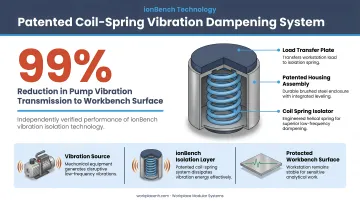
Integrated noise reduction enclosures deliver approximately 15 dB(A) noise reduction, critical for open-plan labs. An overheating temperature alarm protects vacuum pumps from thermal damage, and lockable casters enable full bench mobility for lab reconfiguration.
ionBench's instrument-specific online configurator and downloadable compatibility PDFs simplify specification for facility planners purchasing multiple systems across standardized platforms.
| Criteria | Details |
|---|---|
| Key Features | Patented 99% vibration dampening (coil springs); 15 dB(A) noise reduction enclosure; overheating alarm; fully mobile with lockable casters; up to 30% lab space savings vs. conventional layouts; OEM-specific compatibility guides |
| Best For | Labs prioritizing noise reduction and vibration isolation; open-plan multi-instrument facilities; environments where turbomolecular pump longevity and uptime are primary ROI drivers |
| Customization & Origin | Configurable via online tool; instrument-specific sizing guides; European-manufactured (France); ISO 9001:2015 certified; global distribution |
Kewaunee Scientific Corporation
Founded in 1903, Kewaunee Scientific is a century-old American laboratory furniture manufacturer with headquarters in Statesville, North Carolina. The company's portfolio spans steel and wood casework systems used across academic, pharmaceutical, industrial, and government laboratories—offering facility planners a single-source solution for complete lab outfitting.
Kewaunee's ENTERPRISE Free Standing Laboratory Workstation System provides modular component-based configurations with integrated utility service fittings, electrical receptacles, and flexible storage options. Work surface materials include Kemresin epoxy resin (1-inch thick, SEFA 3 chemical resistance certified), Type 304/316 stainless steel, and maple butcher block—each optimized for specific laboratory applications.
The modular casework approach allows MS benches to integrate seamlessly with broader lab furniture systems, ensuring aesthetic consistency and simplified specification for new construction or renovation projects.
| Criteria | Details |
|---|---|
| Key Features | Kemresin epoxy resin tops (SEFA 3 certified); Type 304/316 stainless steel options; modular casework integration; utility service coordination; steel and wood construction variants; chemical/solvent resistance |
| Best For | Full lab fit-outs where MS benches must match institutional furniture standards; regulated pharmaceutical and government environments requiring documented material compliance |
| Customization & Origin | Quote-based custom configurations via dealer network; American-manufactured; 120+ years laboratory furniture expertise |
IAC Industries
Operating since 1971 from Brea, California, IAC Industries—now a division of Treston Group—manufactures heavy-duty industrial and laboratory workbenches with a 10-year warranty. The company serves industrial, laboratory, cleanroom, and electronics sectors with modular workbench systems engineered for sustained heavy-load applications.
Load capacity ratings reach 2,000 lbs on select configurations (Workmaster E-Series Pedestal Bench), with standard models supporting 750-1,500 lbs. ESD-safe laminate surfaces with factory-tested grounding provisions address electronics assembly requirements, while height-adjustable variants (30-36 in. via telescoping H-frame legs) accommodate ergonomic needs.
The MTS (Multi-Task Systems) modular accessory framework provides surface-mounted and frame-mounted options—shelving, overhead storage, suspended drawers, and utility panels—allowing labs to configure MS benches for evolving peripheral requirements without replacing base structures.
| Criteria | Details |
|---|---|
| Key Features | Heavy-duty steel frame (up to 2,000 lb capacity); ESD-safe surface options; height-adjustable configurations; MTS modular accessory system (250 lb capacity accessories); industrial-grade construction; 10-year warranty |
| Best For | Quality control labs, industrial analytical environments, facilities requiring MS benches meeting heavy-duty structural and ESD safety requirements |
| Customization & Origin | Modular configurations with accessory customization; California-engineered and manufactured; division of Treston Group |
BenchPro
BenchPro manufactures industrial and laboratory workbenches from facilities in Mexico, with U.S. distribution operations in Tecate, California. The company offers high-capacity bench systems with diverse surface materials and fast-ship availability—practical for labs executing rapid build-outs or instrument expansions.
Weight capacity ratings span 1,200 lbs (Roosevelt cleanroom series) to 20,000 lbs (Harding stainless steel models), with the popular Kennedy series rated at 6,600 lbs. Surface options include 18-gauge Grade 304 stainless steel, ESD LisStat laminate (ANSI/BIFMA compliant), 3/4-inch phenolic resin, and 1-3/4-inch solid maple butcher block.
Lead times of 1-5 working days for 1-10 bench orders enable procurement teams to meet aggressive project schedules. Standard sizing ranges from 48-96+ inches with L-shaped and U-shaped custom configurations available.
| Criteria | Details |
|---|---|
| Key Features | High weight capacity (1,200-20,000 lbs depending on series); multiple surface materials (stainless steel, ESD laminate, phenolic resin, maple); height adjustment (30-36 in.); cleanroom-rated variants (Roosevelt series); fast-ship availability |
| Best For | Labs sourcing MS benching on compressed timelines; facilities needing high load capacity without extended custom fabrication; production and QC environments |
| Customization & Origin | Standard and custom sizing; 1-5 day lead times for stock configurations; manufactured in Mexico with U.S. distribution (Tecate, CA) |
How We Chose the Best MS Bench Manufacturers
These manufacturers were selected through evaluation criteria tied directly to MS operational requirements and long-term business outcomes:
- MS-specific engineering: Benches must address load distribution for instrument stacks, vibration transmission, and vacuum pump noise, not just general lab furniture specs. ionBench's 99% vibration dampening and Workplace's custom pump enclosures are examples of this specialization.
- Load capacity and material certification: A Thermo Orbitrap with LC stack and pumps can exceed 300 kg, so benches rated below 500 lb (227 kg) create safety hazards. SEFA 3 chemical resistance and ESD compliance are baseline material requirements.
- Vibration and noise control: Pump vibration shortens turbomolecular bearing life and degrades spectral quality. Engineered solutions (dampening systems, noise enclosures, structural isolation) protect both equipment and analysts.
- Modularity for long-term use: MS instruments turn over on 5-7 year cycles. Modular frameworks like Workplace's bolt-on accessories and IAC's MTS system adapt to new instrument footprints without replacing the bench entirely.
- Domestic manufacturing lead times: US-fabricated benches (Workplace, Kewaunee, IAC) deliver in 30-45 days for custom orders versus 90+ days for offshore production, with simpler post-installation support.
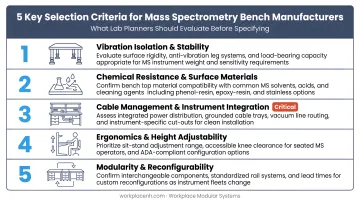
Common buyer mistakes include selecting general industrial benches without MS-specific load verification, overlooking vibration transmission risks, and underestimating future reconfiguration needs when instrument portfolios expand.
Conclusion
The mass spectrometry bench directly determines turbomolecular pump service life, measurement precision, workflow efficiency, and regulatory compliance. Bench selection carries the same weight as instrument specification—get it wrong, and the instrument suffers regardless of its quality.
When evaluating manufacturers, assess three critical factors:
- Scalability: Modular, reconfigurable designs prevent costly replacements as instrument fleets grow or platforms change
- Regulatory fit: Surface materials, cleanability, and construction methods must align with your environment—pharmaceutical GMP, clinical diagnostics, or academic safety standards
- Support model: Manufacturers with in-house fabrication and engineering teams can service, modify, or expand benches after installation, reducing long-term friction
Workplace Modular Systems starts with your MS workflow and instrument configuration, then engineers benches from their 90,000 sq ft New Hampshire facility to fit those exact requirements. Contact their team at 800.258.9700 to discuss modular lab bench systems built for your analytical environment.
Frequently Asked Questions
What are the most commonly used types of mass spectrometers and mass analyzers?
The most common MS types include triple quadrupole, Q-TOF (Quadrupole Time-of-Flight), Orbitrap (FTMS), ion trap, MALDI-TOF, and single quadrupole systems. Bench requirements vary significantly: Q-TOF and Orbitrap instruments have larger footprints and higher weights than single quadrupoles, requiring greater load capacity and surface area to accommodate LC stacks and peripheral equipment.
What industries use mass spectrometry?
Key industries include pharmaceuticals and drug development, clinical diagnostics, environmental testing (including PFAS monitoring), food safety, forensics, proteomics/metabolomics research, and materials science. Each sector imposes different bench requirements: pharmaceutical labs prioritize chemical resistance, electronics environments require ESD protection, and clinical facilities demand cleanability for regulatory compliance.
Is QTOF high resolution?
Yes, Q-TOF (Quadrupole Time-of-Flight) instruments are classified as high-resolution mass spectrometers. Agilent's Revident LC/Q-TOF achieves mass accuracy within ±1 ppm across broad abundance ranges. Their larger footprint relative to single quadrupole systems makes bench sizing and load capacity planning especially critical during facility design.
What should I look for when selecting a mass spectrometry bench?
Key selection criteria:
- Load capacity: Verified rating for full system weight (instrument + pumps + LC modules)
- Vibration dampening: Provisions to protect turbomolecular pumps
- Noise management: Vacuum pump isolation, especially in open labs
- Work surface: Chemical-resistant material appropriate for your reagents
- Cable routing: Organized conduits for tubing and power
- Modularity: Adaptable design to accommodate future instrument changes
How important is vibration dampening for a mass spectrometry bench?
Vibration dampening is critical. Unmanaged vacuum pump vibration transmits to turbomolecular pumps inside the MS instrument, reducing bearing lifespan, increasing maintenance frequency, and potentially degrading instrument sensitivity and mass accuracy. ionBench's 99% vibration reduction systems demonstrate how engineered dampening protects both equipment longevity and measurement quality.
Can a standard lab bench be used for a mass spectrometer?
Standard lab benches typically lack the load ratings (300+ kg for many systems), vibration isolation, and cable management that protect instrument performance and analyst safety. Purpose-built MS benches are strongly recommended wherever equipment uptime and measurement accuracy directly impact outcomes.