Introduction
Real-world samples are messy. Biological fluids, environmental matrices, and food products contain thousands of co-present molecules — and most analytical techniques struggle to untangle them reliably.
Liquid chromatography-mass spectrometry (LC-MS) solves this by combining two complementary methods: liquid chromatography separates compounds by their physicochemical properties, while mass spectrometry identifies them by mass-to-charge ratio (m/z). Together, they handle complexity that neither technique could manage alone.
This guide is written for lab scientists, pharmaceutical researchers, and QC professionals who need a clear, practical understanding of how LC-MS works, what its key variants offer, and where the technology is applied across industries. It also addresses the physical lab environment, because even the most sophisticated instrument underperforms on the wrong bench.
TL;DR
- LC-MS separates compounds by chromatography, then identifies and quantifies them by m/z ratio using a mass spectrometer.
- The interface (ESI or APCI) is the critical bridge converting liquid-phase analytes into detectable gas-phase ions.
- LC-MS/MS adds a fragmentation step, dramatically improving sensitivity and selectivity in complex matrices.
- Fields from drug development and proteomics to environmental monitoring, food safety, and clinical diagnostics all rely on LC-MS.
What Is LC-MS and How Does It Work?
Agilent defines LC-MS as combining "the separation power of liquid chromatography with the direct mass measurement of a mass spectrometer as the detector." The dual selectivity is what makes it indispensable: LC separates by polarity, size, or charge; MS distinguishes by mass. Together, they handle sample complexity that neither can manage alone.
The LC Component: Separating the Mixture
In HPLC and UHPLC, samples dissolved in solvent are pumped at high pressure through a packed column. Compounds interact differently with the stationary phase and elute at characteristic retention times based on those interactions.
IUPAC classifies liquid chromatography into five mechanism categories:
- Adsorption — compounds bind to a solid surface based on polarity
- Partition — distribution between mobile and stationary liquid phases
- Ion-exchange — separation by charge interaction
- Size-exclusion — separation by molecular size
- Affinity — selective binding to a biospecific ligand
Reversed-phase partition chromatography (typically C18 columns) dominates LC-MS workflows, particularly for hydrophobic analytes and proteomics. Its compatibility with aqueous mobile phases makes it well-suited for biological and environmental samples.
The MS Component: Identifying and Quantifying by Mass
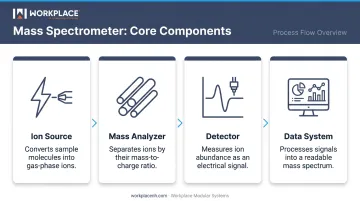
A mass spectrometer has four core components:
- Ion source — converts analytes from the LC eluent into gas-phase ions
- Mass analyzer — separates ions by m/z using electric and magnetic fields (quadrupole, TOF, ion trap, or hybrid Q-TOF)
- Detector — records ion intensities, typically via electron multiplication
- Data system — processes signals into spectra and chromatograms
The mass analyzer cannot differentiate compounds without prior separation. Thousands of molecules share overlapping mass ranges — co-eluting species produce mixed spectra that obscure accurate identification. LC resolves that problem before ions ever reach the analyzer.
Interpreting LC-MS Output
LC-MS produces two complementary data outputs:
- Total Ion Chromatogram (TIC): Plots ion intensity against retention time; each peak represents a compound eluting from the column. Selected Ion Monitoring (SIM) mode narrows detection to specific m/z values, improving sensitivity for known targets.
- Mass Spectrum: At any retention time point, the x-axis shows m/z values and the y-axis shows ion abundance. The parent ion peak confirms molecular mass; isotopic patterns and fragmentation profiles support structural identification.
The LC-MS Interface: Connecting Two Incompatible Systems
LC operates at atmospheric pressure with a flowing liquid. MS requires high vacuum. Bridging these two conditions — without losing analyte, disrupting the vacuum, or altering the compound's chemical identity — is the central engineering challenge of LC-MS, and the interface is where that challenge gets solved.
Electrospray Ionization (ESI)
ESI is the most common LC-MS interface. The LC eluent passes through a metal capillary held at high voltage (typically ±3–5 kV), creating a fine mist of charged droplets. Heat and drying gas evaporate the solvent, leaving behind analyte ions that enter the MS inlet.
ESI is best suited for:
- Polar, thermally labile compounds
- Large biomolecules (peptides, proteins) — it can generate multiply charged ions, which allows high-mass analytes to fall within typical m/z detection ranges
- Biological and pharmaceutical matrices
Atmospheric Pressure Chemical Ionization (APCI) and APPI
Shimadzu describes APCI as vaporizing the eluent in a heated nebulizer, then ionizing analyte molecules via corona discharge. It handles higher flow rates than ESI and is better suited for:
- Low- to medium-polarity compounds
- Thermally stable, volatile analytes
- Lipids, steroids, and fat-soluble vitamins
APPI (atmospheric pressure photoionization) uses short-wavelength UV light instead of corona discharge, extending coverage to non-polar compounds that neither ESI nor APCI ionizes effectively. Shimadzu's DUIS-2020 combines ESI and APCI in a single integrated probe for simultaneous measurement — useful when a method covers chemically diverse analytes.
The table below summarizes which source fits which analyte class:
| Source | Best For | Avoid When |
|---|---|---|
| ESI | Polar, large biomolecules, thermally labile | Very non-polar analytes |
| APCI | Low/medium polarity, thermally stable | Large biomolecules, thermally labile compounds |
| APPI | Non-polar compounds | High-polarity, ionic analytes |
LC-MS/MS: How Tandem Mass Spectrometry Improves Performance
In complex matrices — plasma, urine, environmental water — many compounds share similar m/z values. Single-stage MS cannot reliably distinguish them. LC-MS/MS solves this by adding a second stage of mass filtering.
The standard instrument for tandem MS is the triple quadrupole (QqQ):
- Q1 selects the precursor ion of interest
- Q2 (collision cell) fragments it via collision-induced dissociation (CID), producing characteristic product ions
- Q3 filters for a specific product ion
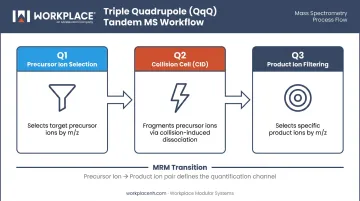
The precursor-to-product ion pair is called an MRM transition (Multiple Reaction Monitoring) — a unique mass fingerprint for each analyte. Sciex describes MRM/QqQ as the gold standard for targeted quantitative measurements due to speed, sensitivity, dynamic range, and specificity.
Four Tandem MS Scan Modes
- Product ion scan — fragments a selected precursor to map all product ions (useful for structural characterization)
- Precursor ion scan — identifies all precursors that generate a specific product ion
- Neutral loss scan — detects compounds that lose a characteristic neutral fragment
- SRM/MRM — monitors one or more specific precursor→product transitions for quantitation
Of these four modes, SRM/MRM dominates quantitative bioanalysis. Specificity is high because both the precursor mass and the fragmentation pattern must match, which substantially reduces false positives from co-eluting matrix components.
Why LC-MS/MS Enables Faster Methods
Because MRM transitions can differentiate co-eluting compounds by their unique fragmentation signatures, complete chromatographic resolution of every analyte is not always required. Agilent's Dynamic MRM documentation notes this directly: MRM can remove the need to resolve compounds to baseline. The result is shorter run times and higher sample throughput without sacrificing accuracy.
Key Applications of LC-MS Across Industries
Pharmaceutical, Bioanalytical, and Clinical
LC-MS/MS is the foundation of regulated bioanalysis in drug development. Core applications include:
- Pharmacokinetics (PK/ADME) — quantifying drug candidates in plasma, urine, and tissue under FDA/ICH M10 guidelines
- Metabolite identification — profiling drug metabolites in discovery and development
- Biomarker discovery and validation — measuring low-abundance proteins and small molecules
- Anti-drug antibody (ADA) detection — hybrid LBA-LC-MS/MS platforms support ADA isotyping for immunogenicity characterization
ICH M10 (adopted 2022) governs bioanalytical method validation for nonclinical toxicokinetic and clinical pharmacokinetic studies. Full validation covers selectivity, matrix effects, calibration, accuracy, precision, carryover, and stability.
Environmental, Food Safety, and Industrial
The food safety testing market is projected to grow from USD $23.98B in 2025 to USD $37.13B by 2031, with chromatography and spectrometry growing at 8.53% CAGR — driven largely by LC-MS/MS adoption in multi-contaminant screening.
Specific applications include:
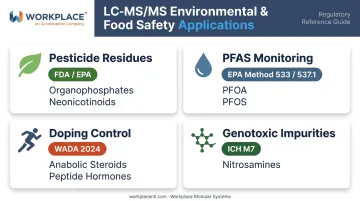
- Pesticide residue analysis — FDA ORA harmonized multi-residue methods using LC-MS/MS
- PFAS monitoring — EPA Methods 537.1, 533, and 1633 covering drinking water, wastewater, soil, and sediment
- Doping control — WADA TD2023IDCR sets minimum criteria for chromatographic-MS confirmation of prohibited substances
- Genotoxic impurities — ICH M7(R2) governs DNA-reactive mutagenic impurities; validated UPLC-MS/MS methods achieve limits of quantification at 15 ppm
Omics Applications
- Proteomics — bottom-up LC-MS/MS identifies thousands of peptides from complex biological samples in a single run via peptide mass fingerprinting and database searching
- Metabolomics — a 2024 LC-MS assay quantified 721 compounds in serum/plasma, demonstrating the scale of coverage validated methods can achieve
- Rapid diagnostics — an eLife study using SISCAPA peptide enrichment with LC-MS demonstrated 95% positive percent agreement and 100% negative percent agreement for SARS-CoV-2 detection in clinical samples with Ct ≤ 30
Strengths, Limitations, and Lab Environment Considerations
LC-MS Strengths
- Sensitivity — detection at picomolar to nanomolar concentrations (method-dependent)
- Selectivity — dual separation by retention time and m/z eliminates many false positives
- Multiplexing — simultaneous quantification of dozens of analytes in a single injection via MRM
- No immunological reagents — unlike ligand-binding assays, no batch-to-batch antibody variability
- Wide linear dynamic range — important for samples spanning several orders of concentration magnitude
- Automation-compatible — high-throughput autosamplers and data processing pipelines are well-established
Key Limitations
- Instrument cost — capital equipment, service contracts, consumables, and validation workload are substantial
- Operator expertise — method development, troubleshooting, and regulatory compliance require specialized training
- Mobile phase restrictions — only volatile buffers (ammonium acetate, ammonium formate) are MS-compatible; non-volatile salts precipitate at the ion source and suppress signal
- Matrix effects — ion suppression or enhancement from co-eluting matrix components requires careful evaluation per ICH M10
- Carryover and contamination — ICH M10 requires carryover assessment; blank responses after high-concentration samples should not exceed 20% of the LLOQ response
The Physical Lab Environment
LC-MS instruments are demanding tenants. A typical triple quadrupole or Q-TOF system can weigh several hundred pounds with associated HPLC pumps, autosamplers, and vacuum pumps. They require stable surfaces, nitrogen supply lines, solvent waste routing, and clear ergonomic access for daily operation and maintenance.
Those physical demands make the workstation a functional part of the analytical setup, not just furniture. Workplace Modular Systems manufactures LC-MS workstations rated to 1,000 lbs with vibration-dampening welded steel frames, built to support LC-MS, GC-MS, and ICP-MS instrumentation. Their bench configurations include:
- Integrated vacuum pump enclosures and independent solvent storage
- Tubing and wiring cutouts for HPLC pump connections, autosampler tubing, and detector wiring
- Utility routing for nitrogen, vacuum, and specialty gas lines
- Chemical-resistant work surfaces (epoxy resin, phenolic resin, or stainless steel Type 304) with SEFA 8 compliance
- Height-adjustable configurations (30"–37" or 35"–42") for ergonomic operator access during sample loading and maintenance
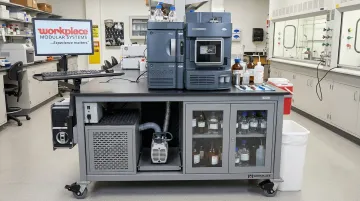
The workstations are available in 9 standard configurations and custom options, with compatibility validated for instruments from Waters, Agilent, Thermo Fisher, Sciex, Shimadzu, Bruker, Beckman Coulter, and PerkinElmer. Biogen, for example, worked with Workplace Modular Systems to build purpose-designed mass spectrometry workstations engineered specifically for their instrumentation requirements.
Standard custom orders ship in 30–45 days from the Londonderry, NH manufacturing facility, with Quick Ship options available in under 14 days.
Frequently Asked Questions
What is the principle of liquid chromatography mass spectrometry?
LC-MS combines chromatographic separation (where compounds interact differently with a stationary phase based on polarity, size, or charge) with mass spectrometric detection based on m/z ratios. An ionization interface converts liquid-phase analytes into gas-phase ions, enabling identification and quantification of target compounds in highly complex mixtures.
How is liquid chromatography coupled with mass spectrometry?
The LC and MS connect through an atmospheric pressure ionization (API) interface, most commonly ESI or APCI. This interface converts the liquid LC eluent into gas-phase ions without disrupting the MS vacuum, stripping solvent while transferring analyte ions into the mass analyzer.
How do you read LC-MS results?
Results come in two forms: a chromatogram (ion intensity vs. retention time) that shows when each compound elutes, and a mass spectrum at each time point (ion abundance vs. m/z) that confirms compound identity. Quantification uses calibration curves correlating ion response to known concentrations.
What are the applications of liquid chromatography mass spectrometry?
Major application areas include pharmaceutical drug development and pharmacokinetics, biomarker analysis, proteomics and metabolomics, PFAS and pesticide monitoring in environmental samples, food safety contaminant screening, and clinical diagnostics.
Is LC-MS the same as HPLC?
HPLC is the liquid chromatography component of LC-MS and typically uses UV or optical detection. LC-MS replaces that optical detector with a mass spectrometer, providing superior sensitivity, selectivity, and structural identification capability compared to HPLC/UV alone.
What is the difference between LC-MS and LC-MS/MS?
LC-MS uses a single-stage mass analyzer. LC-MS/MS adds a collision cell and second mass filter, fragmenting a selected precursor ion into characteristic product ions. The resulting MRM transition (precursor mass paired with a specific product ion) provides far better sensitivity and selectivity, making it the standard for quantitative bioanalysis in complex matrices.