Introduction
Cleanroom workstations carry high stakes in semiconductor and pharma manufacturing. A single wrong choice can compromise ISO classifications, trigger contamination events that cost millions, and halt production lines. TSMC's 2019 photoresist contamination incident resulted in an estimated $550 million loss, damaging thousands of wafers and delaying shipments to major clients. One contaminated workstation can erase a quarter's profit.
Those stakes make workstation selection a compliance decision, not just a procurement one. Standard industrial benches don't qualify — cleanroom environments require simultaneous control of particulate generation, electrostatic discharge (ESD) risk, chemical exposure, and ergonomic compliance.
That means sealed frames, electropolished stainless steel tops, or static-dissipative laminates rated to ISO 14644-1 classifications, plus industry-specific standards like cGMP for pharma or ANSI/ESD S20.20 for semiconductor.
This guide evaluates 10 manufacturers against criteria that matter to facility planners: cleanroom class compatibility, material specifications, customization depth, and industry fit — so you can compare options without sifting through marketing brochures.
Key Takeaways
- ISO class, cGMP, and ANSI/ESD compliance requirements vary by industry — choose a manufacturer that covers your specific regulatory framework
- Key differentiators: customization depth, ISO classification support, ESD vs. stainless steel options, and lead times
- Workplace Modular Systems stands out for 65+ years of manufacturing experience, modular reconfigurability, and factory-direct customization
- Pricing ranges from $320 (laminate) to $2,155+ (certified stainless steel), with 316L electropolished configurations starting above $2,000
- Use the comparison tables below to match each manufacturer's strengths to your facility's ISO class and regulatory requirements
What Are Cleanroom Workstations and Why Do They Matter in Semiconductor and Pharma?
Cleanroom workstations are purpose-built work surfaces that generate minimal particulates and integrate with controlled-environment infrastructure. Unlike standard industrial benches, they rely on sealed construction, low-outgassing materials, and finishes engineered to prevent particle shedding.
Material selection directly impacts ISO class integrity:
- Stainless steel (304 or 316L electropolished): Non-porous surfaces resist microbial adhesion and facilitate sterilization in pharmaceutical cleanrooms, meeting cGMP requirements
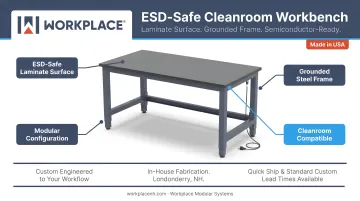
- ESD-safe laminates: Static-dissipative surfaces with resistance between 1.0 x 10^6 and 1.0 x 10^9 ohms (per ANSI/ESD S20.20) prevent electrostatic discharge damage to semiconductor components
- Powder-coated sealed steel: Smooth, cleanable frames suitable for ISO 7-8 environments where lower contamination risk exists
- Chemical-resistant epoxy/phenolic resin: Withstands harsh reagents in pharma labs while maintaining surface integrity
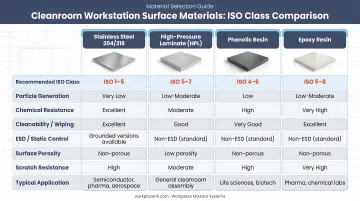
ISO 14644-1 defines particle count thresholds that drive workstation specs. Semiconductor lithography typically requires ISO 4-5 (Class 10-100) environments; aseptic pharmaceutical filling requires ISO 5 / EU GMP Grade A. Workstation surface material, finish, and frame sealing must match the target ISO class.
Market context: The global cleanroom technology market was valued at $7.69 billion in 2024 and is projected to reach $10.82 billion by 2030, driven by expanding semiconductor fab investment and pharmaceutical facility construction. That growth has brought more vendors into the market — which makes evaluating them harder. The 10 manufacturers below have verifiable semiconductor and pharma track records worth examining.
Top 10 Cleanroom Workstation Manufacturers for Semiconductor and Pharma
Each manufacturer below was evaluated on cleanroom classification compatibility, material and compliance standards, customization capability, industry-specific client base, and post-sale support quality. Use the summary tables to compare at a glance, then review the full entry for specifications relevant to your facility's ISO class.
1. Workplace Modular Systems
Workplace Modular Systems has been manufacturing ergonomic, modular workstations since its formal founding in 1959 — over 65 years of continuous production from a 90,000 sq ft facility in Londonderry, NH. The company serves pharma, medical device, and R&D clients including Biogen, Vertex, Pfizer, Abbott, and Novo Nordisk.
What sets them apart:
- Starts every project with a workflow assessment before specifying any products — not a catalog-first approach
- Handles the full production chain in-house: design, metal fabrication, welding, and powder coating under one roof
- Extensive modular parts library lets workstations be reconfigured as cleanroom layouts or ISO classification requirements change
- All components manufactured domestically at the Londonderry, NH facility
Cleanroom capabilities:
- Stainless steel (Type 304 and 316) work surfaces compatible with ISO 5+ environments
- Epoxy resin tops rated for ISO 7+ with heavy chemical resistance
- Powder-coated steel frames designed for ISO 8 environments and below
- ESD-safe worksurfaces meeting ANSI/ESD S20.20 standards
- Material data sheets and cleanroom compatibility certifications available on request
| Cleanroom Class Compatibility | ISO 5 through ISO 8, depending on material selection |
|---|---|
| Key Features | Modular reconfigurability, ergonomic height adjustment (manual and electric), ESD-safe surface options, stainless steel tops (Type 304/316), powder-coated sealed frames, custom enclosures, chemical-resistant epoxy/phenolic resin |
| Best For | Pharmaceutical labs, medical device manufacturing, R&D and life sciences cleanrooms requiring adaptable, American-made workstations with consultative support |
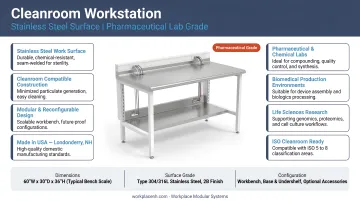
Standard lead times: 30-45 days for custom configurations.
2. Terra Universal
Based in Fullerton, California and serving cleanroom markets since 1976, Terra Universal offers one of the broadest in-stock catalogs of cleanroom furniture and workstations in the US — with transparent online pricing and fast delivery options that are uncommon in this market.
Differentiators:
- Broadest verified ISO range: ISO 3 through ISO 8
- Transparent online pricing (rare in this market)
- Single-source supplier for workstations and cleanroom accessories
Product lines include:
- BioSafe all-stainless cleanroom tables certified at ISO 6, with select models at ISO 4-5
- ErgoHeight auto-adjustable workstations
- ClassOne and TMC CleanBench models with vibration isolation
- Surface options: 304 stainless steel (standard), 316L stainless steel (upgrade), epoxy resin, phenolic resin, static-dissipative laminate, polypropylene
| Cleanroom Class Compatibility | ISO 3 through ISO 8 (widest verified range) |
|---|---|
| Key Features | Stainless steel and static-dissipative laminate tops, perforated surfaces, modular shelving integration, available with casters, vibration isolation options |
| Best For | Semiconductor and pharma facilities needing fast-turnaround, catalog-based cleanroom furniture with broad accessory selection |
Verified pricing: BioSafe 304 SS tables range from $1,326 (24"W solid top) to $2,155 (96"W x 36"D perforated top).
3. IAC Industries
IAC Industries has been producing cleanroom workbenches and industrial furniture since 1971. Now part of Treston Group, the California-based manufacturer maintains dedicated product lines engineered for ESD-sensitive and contamination-controlled environments.
Known for:
- Range of cleanroom bench configurations including stainless steel and ESD-safe options
- Isles AirClean workstations with vertical and horizontal laminar flow models
- 100% Made in USA manufacturing
Technical specs:
- Recommended for Class 100 (Federal Standard 209E) requirements, approximately ISO 5
- Cold-rolled steel frames with powder-coated finish
- High-pressure postforming horizontal grade laminates with cleanroom seal
- 750 lbs maximum load capacity
| Cleanroom Class Compatibility | Class 100 / ISO 5 recommended |
|---|---|
| Key Features | ESD-safe worksurfaces, stainless steel frame options, adjustable height, modular upper shelving, welded frame construction, chemical-resistant laminate with cleanroom seal |
| Best For | Semiconductor assembly and electronics manufacturing cleanrooms where ESD control is a primary requirement |
Customization available for size, surface material, and accessory integration.
4. Clean Air Products
Based in Minneapolis, Minnesota and operating since 1969, Clean Air Products manufactures both cleanroom structures and cleanroom furnishings including workstations, fan filter units, and pass-through chambers.
Advantage:
- Source cleanroom workstations alongside air-handling infrastructure from a single vendor
- Mid-range pricing with standard and stainless steel configurations
Product line:
- CAP62CT: Solid-top stainless steel cleanroom table (16-gauge Type 304, #4 finish; welded 2x2 tubular SS frame)
- CAP61LT: Plastic laminate cleanroom table
- CAP64CT: Perforated stainless steel cleanroom table
| Cleanroom Class Compatibility | Compatible with cleanrooms rated from Class 100,000 to Class 10 (ISO 8 through ISO 4) |
|---|---|
| Key Features | Painted steel and stainless steel workstation options, washdown-compatible surfaces, modular configurations, Type 304 stainless steel with welded tubular frames |
| Best For | Facilities seeking workstations bundled with cleanroom airflow equipment from one supplier |
Pricing: Quote-based; not publicly listed.
5. Formaspace
Formaspace is an Austin, Texas-based manufacturer of industrial and laboratory workstations with custom-built options for cleanroom, pharmaceutical, and semiconductor environments, known for highly configurable bench designs.
Stands out for:
- Direct-to-manufacturer model with heavily customized workstations
- Precise material specifications tailored to individual facility cleanroom classifications
- 100% made in the USA; ships fully welded from Austin, TX
Surface materials available:
- Stainless steel with electropolished and passivated options
- Chemical-resistant phenolic, epoxy, HDPE, polypropylene
Product lines:
- Workbenches (ESD safe, electropolished, mobile)
- Workstations (sink workstations, islands)
- Stainless steel and pharmaceutical tables
- Biosafety, flame, acid, and UVC sterilization cabinets
| Cleanroom Class Compatibility | Designed to meet typical ISO requirements; specific class numbers not stated (verify with manufacturer) |
|---|---|
| Key Features | Custom stainless steel tops (electropolished available), chemical-resistant surfaces, ergonomic sit-stand options, heavy-duty frame construction, custom enclosures |
| Best For | Pharma and biotech cleanrooms requiring fully bespoke workstation specifications and high load capacity |
Pricing: Quote-based via Design Consultant.
6. RDM Industrial Products
RDM Industrial Products is a US manufacturer-direct supplier of laboratory and cleanroom tables with a broad model lineup including stainless steel, ESD, and laminar flow workstations designed for ISO-classified environments.
Differentiates through:
- Wide catalog of standard models adaptable to cleanroom use
- Electropolished stainless steel models rated for Class 10 environments
- Sealed laminate frame construction minimizing particulate generation
Product options:
- Vibration damping workbenches with plastic laminate, chemical-resistant, ESD/static-control, solid surface, and solid wood top options
- LF-102P-ISO series vertical laminar flow models with HEPA or ULPA filtration and vibration isolation
| Cleanroom Class Compatibility | Electropolished stainless steel models rated for Class 10; sealed steel frame models suitable up to Class 100 (verify current ISO equivalents with manufacturer) |
|---|---|
| Key Features | Fully welded tubular steel frames, stainless steel adjustable-height models, ESD laminate surfaces, vibration isolation options, HEPA/ULPA laminar flow models |
| Best For | Labs and semiconductor facilities needing a wide selection of standard cleanroom table models with verifiable contamination-control specs |
Web contact forms were under construction at time of research — detailed specifications may require a direct phone inquiry.
7. BenchPro
BenchPro is a US-based workbench manufacturer producing cleanroom-compatible benches for electronics, semiconductor, and pharmaceutical applications, with strong ESD product lines and configurable frame systems.
Known for:
- Competitive lead times
- Dedicated ESD workstation lines that meet ANSI/ESD standards
- Structural compliance with ANSI, BIFMA, DIN, and GSA standards
Dewey Series cleanroom ESD laminate workbenches:
- Cleanroom Class 100 (ISO 5) certified
- 16-gauge cold-rolled steel, powder-coated frames (Blue, Gray, Black, White, Dark Blue, Beige)
- 1.2-inch thick ESD laminate top, sealed on all six sides
- 5,000 lb apron load capacity
- Recessed legs, round edge design
| Cleanroom Class Compatibility | Cleanroom Class 100 (ISO 5) certified |
|---|---|
| Key Features | ESD-safe laminate surfaces (White, Black, Light Gray, Dark Gray, Clear), grounded frame options, adjustable height, upper shelf and accessory integration, passes ESD Association Standards |
| Best For | Electronics assembly and semiconductor cleanrooms with strong ESD control requirements and standard bench configurations |
Pricing: $378-898 via distributor Midwest Production Supply; quantity discounts from 7% (2-4 units) to 14% (25+ units).
8. Kewaunee Scientific
Founded in 1906, Kewaunee Scientific is one of the longest-running US laboratory furniture manufacturers, with international operations serving pharmaceutical, biotech, and research environments. Their product range covers casework, benching, and storage — built to regulatory standards.
Differentiates through:
- cGMP-aligned design capability
- Comprehensive laboratory furniture ecosystems (casework, benching, storage)
- Experience with large-scale pharma facility fit-outs
Note: No dedicated cleanroom workstation product line or specific ISO class rating was confirmed on kewaunee.com during research. Kewaunee's India division lists stainless steel laboratory casework and worktables. Cleanroom capability should be verified directly with the manufacturer.
| Cleanroom Class Compatibility | Not specified; verify directly with manufacturer |
|---|---|
| Key Features | Chemical-resistant tops, stainless steel options (via India division), modular casework integration, custom sizing, compliance documentation support |
| Best For | Pharmaceutical and biotech facilities requiring integrated lab furniture ecosystems with regulatory documentation support (confirm cleanroom-specific offerings before specifying) |
9. Cleatech LLC
Cleatech LLC is a California-based manufacturer specializing in cleanroom equipment and furniture including workstations, desiccator cabinets, and storage units for semiconductor, medical device, and pharma markets.
Stands out for:
- Focus on contamination-sensitive niche products
- Certified distributor for BenchPro cleanroom workbenches
- Transparent online pricing
Product offerings:
- Class 100 (ISO 5) rated cleanroom workbenches with cleanroom laminate or ESD laminate tops (24-36 inch widths)
- Heavy-duty 14-gauge Type 304 stainless steel tables in electropolished or brushed finishes
- Solid top and perforated top options
- Alcohol-wiped and cleanroom bagged delivery
| Cleanroom Class Compatibility | Class 100 (ISO 5) rated |
|---|---|
| Key Features | Static-dissipative and stainless steel surfaces, electropolished or brushed finish options, solid and perforated tops, cleanroom packaging (alcohol-wiped and bagged), modular configurations |
| Best For | Semiconductor and medical device manufacturers needing cleanroom workstations with transparent pricing and quick availability |
Verified pricing:
- Cleanroom laminate workbenches: $320-1,178
- 304 SS tables: $968 (24x24) to $1,912 (36x96)
10. HEMCO Corporation
HEMCO Corporation is a US-based manufacturer of laboratory equipment including fume hoods, modular cleanrooms, and laboratory furniture, with a focus on cleanroom enclosures and controlled-environment structures.
Primary cleanroom offerings:
- Modular HEPA-filtered cleanroom structures (Class 100, 1,000, 10,000, and 100,000)
- HEPA filtration at 99.99% efficiency at 0.3 microns with variable speed control
- Softwall cleanrooms and CCS Containment Control Systems
Casework materials:
- Wall panel surfaces in fiberglass, stainless steel, coated steel, aluminum, or chemical-resistant composite resin
- Polypropylene casework in four grades (standard and three flame-retardant grades)
- Static-dissipative curtains optional
| Cleanroom Class Compatibility | Class 100 through Class 100,000 (for modular cleanroom structures) |
|---|---|
| Key Features | Polypropylene and epoxy resin worksurfaces, chemical and solvent resistant, corrosion-resistant frames, fume hood integration, modular HEPA-filtered enclosures |
| Best For | Pharmaceutical and chemical processing facilities seeking cleanroom enclosures and integrated casework (confirm standalone workstation offerings directly) |
HEMCO's catalog centers on modular cleanroom enclosures and fume hoods. Buyers specifically needing standalone cleanroom workstation tables should confirm furniture availability before specifying.
How We Chose These Cleanroom Workstation Manufacturers
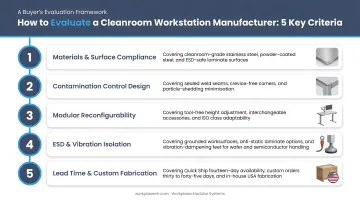
Manufacturers were assessed on five criteria:
- Cleanroom class compatibility (ISO 4-8): Does the manufacturer clearly state and certify ISO class ratings for their workstations?
- Surface material options: Availability of stainless steel (304, 316L electropolished), ESD-safe laminates, and chemical-resistant tops
- Compliance and certification credentials: cGMP alignment, ANSI/ESD S20.20, IEST standards, ASME BPE surface finish specifications
- Customization depth: Can workstations be tailored to specific dimensions, utility routing, or accessory integration?
- Demonstrated experience in semiconductor or pharma sectors: Verifiable client base and project references
Common buyer mistake: Selecting a manufacturer based solely on price without verifying that the material finish and frame construction meet your ISO class's particulate generation requirements. A $500 laminate workbench appears cost-effective until a facility audit requires swapping it for a $2,000 electropolished stainless steel unit.
Beyond the primary five criteria, three secondary factors also influenced rankings:
- Lead time flexibility: Standard expedited options (typically ~14 days) vs. full custom builds (30-45 days)
- US-based manufacturing: Domestic production reduces supply chain exposure for regulated facilities
- Reconfigurability: Can workstations adapt as ISO classification requirements change over time?
Conclusion
Selecting a cleanroom workstation manufacturer involves compliance and operational decisions, not just purchasing criteria. The right vendor should demonstrate working knowledge of your specific ISO class, industry regulation (cGMP or SEMI), and workflow requirements.
Before committing:
- Request material data sheets confirming surface finish specifications (e.g., ASME BPE SF4 for pharma, ANSI/ESD resistance ranges for semiconductor)
- Obtain compliance documentation (ISO 14644 compatibility certifications, ESD test reports)
- Review sample configurations that match your facility's classification and workflow
- Evaluate scalability: Can workstations be reconfigured as classification requirements change without full replacement?
Long-term cost factors include modular reconfigurability, material durability, and the manufacturer's ability to provide documentation during regulatory audits. A workstation that can be adapted in-place delivers better ROI than one requiring disposal and replacement. That ROI case is exactly where vendor selection becomes long-term strategy.
For facilities prioritizing American-made cleanroom workstations with modular reconfigurability, Workplace Modular Systems has over 65 years of manufacturing experience supporting labs and production environments nationwide. Their team provides workflow assessments tailored to your ISO class and compliance requirements. Reach their design specialists at 800.258.9700 or sales@workplacenh.com to start a consultation.
Frequently Asked Questions
What is cleanroom furniture?
Cleanroom furniture refers to purpose-built work surfaces, storage, and seating designed to minimize particulate generation and contamination in controlled environments. These products use sealed or electropolished materials like stainless steel or static-dissipative laminates that comply with ISO cleanroom classification standards.
How expensive is a cleanroom workstation?
Cleanroom workstation costs vary widely based on material, ISO class rating, customization level, and quantity. Verified pricing ranges from approximately $320 for cleanroom laminate workbenches to $2,155+ for certified 304 stainless steel tables. Stainless steel models cost 3-5x more than laminate equivalents; 316L electropolished and custom configurations command premium rates beyond this range.
What ISO class is required for semiconductor cleanrooms?
Semiconductor fabrication typically requires ISO Class 4 to ISO Class 6 environments (equivalent to the former Class 10 to Class 1,000). Critical lithography processes demand ISO Class 3 or better. Workstations must be rated to generate negligible particulates at the specified class level, typically requiring electropolished stainless steel or sealed laminate construction.
What materials are best for pharmaceutical cleanroom workstations?
316L electropolished stainless steel is the preferred material for cGMP pharmaceutical cleanrooms due to its non-porous, easy-to-sterilize surface, typically specified at ASME BPE SF4 finish (Ra ≤0.38 microns). Chemical-resistant epoxy resin or polypropylene tops are used where harsh reagent exposure is a factor, providing durability against acids, bases, and solvents.
What is the difference between ESD and standard cleanroom workstations?
ESD (electrostatic discharge) workstations include grounded, static-dissipative surfaces and frames (resistance >1.0 x 10^6 to <1.0 x 10^9 ohms per ANSI/ESD S20.20) that safely channel static electricity away from sensitive semiconductor components. Standard cleanroom workstations prioritize particulate control through sealed construction and low-outgassing materials (those that release minimal airborne chemicals) but do not address electrostatic risk.
How do I choose the right cleanroom workstation manufacturer for my facility?
Start with your ISO class requirement and regulatory framework (cGMP vs. SEMI), then evaluate manufacturers on:
- Material certifications and compliance documentation (data sheets, ESD test reports)
- Customization capability and lead times
- Consultative design process that fits your workflow, not just catalog offerings