Introduction
ESD damage is deceptive. A discharge that destroys a sensitive component leaves no visible mark — no burn, no crack, no obvious failure. The part passes visual inspection, gets assembled into a board, and fails six months later in the field. By then, the cost of that invisible event has multiplied many times over.
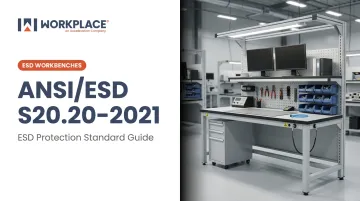
ANSI/ESD S20.20-2021 is the American National Standard that defines how organizations must build, document, and maintain programs to prevent exactly this kind of damage. Published by the ESD Association (ESDA) (the only ANSI-accredited body for electrostatic standards), it covers everything from facility grounding and EPA setup to personnel training and packaging requirements.
This guide is written for quality engineers, ESD program managers, facility planners, and operations leads in electronics manufacturing, aerospace, defense, medical devices, and R&D. If your facility treats S20.20 as a procurement checkbox rather than an operational system, this is where to start.
TL;DR
- ANSI/ESD S20.20-2021 is the current facility-level ESD control standard, covering components sensitive to HBM ≥100V, CDM ≥200V, and isolated conductor voltages above 35V
- Two requirement categories apply: administrative (program plan, training, compliance verification) and technical (grounding, EPA setup, packaging, marking)
- The 2021 revision added Table 4 (packaging requirements), updated definitions, new insulator guidance, and DoD packaging provisions
- Compliance requires documented plans, trained personnel, and regular equipment testing — not just ESD materials on the bench
- Third-party facility certification through ESDA-accredited bodies has required S20.20-2021 since July 1, 2023
What Is ANSI/ESD S20.20?
ANSI/ESD S20.20 is an American National Standard that defines requirements for establishing and maintaining an ESD (electrostatic discharge) control program — protecting electronic parts and assemblies from the rapid, damaging transfer of static charge between objects at different electrical potentials. "ANSI" refers to the American National Standards Institute, which accredits the standard.
The standard is published by the ESD Association, which ESDA describes as the only organization accredited by ANSI to write and produce standards on electrostatics. It operates at the facility and program level, governing how organizations control ESD risk — not how individual components are rated for ESD tolerance. Device-level standards like HBM or CDM test methods tell you how sensitive a part is; S20.20 tells you how to protect it.
History and Current Version
The DoD asked ESDA in 1995 to develop an updated military/commercial ESD control standard. ANSI/ESD S20.20 was introduced in 1999, and the DoD formally adopted it on July 7, 2000. DLA ASSIST records show MIL-STD-1686 as canceled on January 12, 2021, superseded by ANSI/ESD S20.20.
The 2021 version is the current release, succeeding the 2014 edition with these documented changes:
- Updated definitions and terminology
- New Table 4 summarizing ANSI/ESD S541-2019 packaging requirements
- Revised isolated conductor and insulator field measurement guidance
- DoD packaging provisions
- New Informative Annex C on program tailoring
As of July 1, 2023, all ANSI/ESD S20.20 facility certifications must reference the 2021 version.
Why ANSI/ESD S20.20 Matters in Electronics Manufacturing
The Cost Problem Nobody Sees Coming
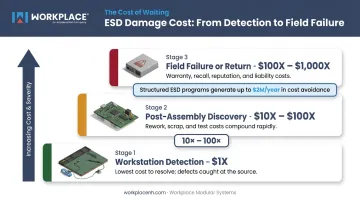
ESD damage is frequently latent: the discharge occurs, the part is weakened, and it passes every test until it fails in use. NASA's NEPP program recorded 35 ESD failures among 232 categorized component incidents from 2001 through 2013, with advanced device unit prices reaching $200,000.
Costs multiply when failures surface after assembly or in-system deployment — a much more expensive point to catch a defect than at the workstation.
Historical program data from Lockheed Missiles and Space Company documented nearly $2 million per year in cost avoidance after implementing a structured ESD program. These aren't abstract numbers — they reflect rework labor, scrap, field returns, and warranty claims that a compliant program directly prevents.
Three Principles That Underpin the Standard
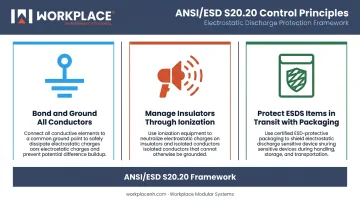
The entire S20.20 framework rests on three control principles:
- Bond and ground all conductors — Personnel, equipment, worksurfaces, and storage items must all connect to a common ground point to eliminate voltage differences that cause discharge
- Manage insulators through ionization — Insulators cannot be grounded; static charge on them must be neutralized using ionization equipment or eliminated by removing them from the EPA
- Protect ESDS items in transit with appropriate packaging — Components outside the EPA need packaging that prevents charge generation and provides discharge shielding
Sensitivity Thresholds
The standard's scope applies to items susceptible to:
- ≥100V HBM (human body model)
- ≥200V CDM (charged device model)
- 35V on isolated conductors
Modern semiconductor devices are trending toward lower CDM thresholds. JEDEC material documents that detailed process monitoring can enable handling of parts with CDM sensitivity below 100V — which means manufacturers handling next-generation components face greater exposure risk, not less, than older device generations did.
Where Compliance Is Required or Expected
| Context | Requirement Status |
|---|---|
| DoD supply chain | MIL-STD-1686 superseded; contractual flowdown applies |
| NASA aerospace programs | Referenced in NASA workmanship standards and JSC-66552 |
| Medical device manufacturing | FDA recognized S20.20-2014 as a consensus standard |
| Third-party certification | ESDA-accredited bodies include BSI, DNV, TÜV SÜD, Intertek, SGS, and others |
What ANSI/ESD S20.20 Requires: Administrative and Technical Elements
The standard has two distinct requirement categories. A facility cannot satisfy S20.20 by addressing only one.
Administrative Requirements
ESD Control Program Plan The master document defining the program's scope, which areas are covered, organizational responsibilities, and implementation approach. It must align with the organization's quality system and be tailored to specific operations.
Training Plan All personnel who handle ESDS items must receive documented training covering:
- ESD fundamentals and underlying risks
- Personal responsibilities at each workstation
- Specific controls in place for their work area
Training must be refreshed at defined intervals — undocumented or expired training is non-compliant.
Compliance Verification Plan Defines how frequently ESD control items will be tested to confirm they remain within acceptable performance limits. Items covered include wrist straps, worksurfaces, floor mats, footwear, and packaging. This is ongoing audit testing, not one-time product qualification.
Technical Requirements
Grounding and Equipotential Bonding Every conductor in the EPA must connect to a common ground point. This covers workstation frames, equipment chassis, floor mats, and personnel via wrist straps or footwear/flooring systems. ANSI/ESD S6.1 governs the grounding system test method referenced here.
ESD Protected Area (EPA) Setup The EPA is the defined zone where ESDS items are handled. Requirements include:
- ESD-compliant worksurfaces with documented resistance values
- Proper flooring or footwear grounding systems
- Controlled access and clear boundary marking
- Removal or neutralization of uncontrolled insulators
Workplace Modular Systems' Custom ESD Workstation Systems are built to meet these physical requirements directly. Each unit includes amino resin laminate worksurfaces (available in ESD White, Gray, and Black), a factory-installed flush-mounted ground bolt with 6-foot ground wire, wrist strap bench mounts, and a welded steel frame that maintains electrical continuity as accessories and loads change. Compliance documentation is included for audit use.

Packaging Requirements (2021 Update) Table 4, added in the 2021 revision, summarizes ANSI/ESD S541-2019 packaging requirements:
| Location | Required Packaging Properties |
|---|---|
| Inside EPA | Low charge-generating, conductive or dissipative materials |
| Outside EPA | Low charge-generating + conductive/dissipative + discharge shielding |
In practice, a component leaving the EPA in a basic dissipative bag, without shielding, does not meet the outside-EPA packaging requirement.
Common Misconceptions About ANSI/ESD S20.20
"Having ESD tools means having a compliant program"
This misconception is the most persistent compliance gap auditors find. The standard requires documented plans, regular testing of control items, trained personnel, and proper equipment qualification. A wrist strap that fails its daily test — or isn't tested and logged at all — provides no documented protection. Without testing logs, even functional ESD tools won't satisfy an auditor.
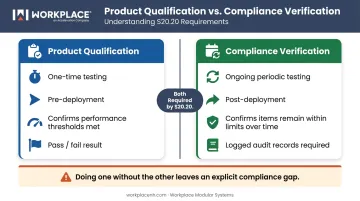
Qualification vs. Compliance Verification
These are two separate requirements that many facilities conflate:
- Qualification — Testing ESD control items against performance thresholds before they're deployed
- Compliance verification — Ongoing periodic testing to confirm items remain within limits over time
Doing one without the other leaves an explicit gap in the S20.20 framework. A mat qualified at installation but never retested may have degraded below its performance threshold months later.
The Insulator Problem
Common workplace items — plastic clipboards, ordinary packaging foam, non-ESD chairs, food containers — are insulators. They cannot be grounded.
ESDA notes that insulators, by definition, cannot lose electrostatic charge through connection to ground. NASA documentation shows that picking a common poly bag off a bench can generate 20,000 volts.
The standard requires facilities to assess every process-essential insulator and either:
- Remove it from the EPA entirely, or
- Neutralize it using an ionization system
An audit will flag those plastic items as nonconformances regardless of how well-grounded everything else is.
Frequently Asked Questions
What is ANSI/ESD S20.20?
ANSI/ESD S20.20 is the leading American National Standard published by the ESD Association that defines requirements for developing, implementing, and maintaining an ESD control program to protect electronic parts and assemblies from electrostatic discharge damage. The current version is ANSI/ESD S20.20-2021.
What are the two requirement categories in ANSI/ESD S20.20?
The standard has administrative requirements (ESD Control Program Plan, Training Plan, Compliance Verification Plan) and technical requirements (grounding systems, personnel grounding, EPA setup, packaging, and marking). A compliant program must address both categories. One without the other falls short of the standard.
What are the key elements of an ANSI/ESD S20.20 ESD control program?
The standard defines eight core elements, each with its own documentation and performance requirements:
- Training
- Product qualification
- Compliance verification
- Grounding and equipotential bonding
- Personnel grounding
- ESD Protected Area (EPA) setup
- Packaging
- Marking
What is the latest version of ANSI/ESD S20.20?
The 2021 edition revised the 2014 version with updated definitions, Table 4 packaging requirements (aligned with ANSI/ESD S541-2019), DoD packaging provisions, and new informative annexes on tailoring and program direction.
What does ANSI/ESD stand for?
ANSI stands for the American National Standards Institute, the body that accredits the standard. ESD stands for electrostatic discharge — the rapid, spontaneous transfer of static charge that can damage sensitive electronic components with no visible warning sign.
Do anti-static wrist straps work?
Properly worn, correctly connected, and regularly tested wrist straps effectively ground personnel and prevent static buildup. The key qualifier is "regularly tested" — the standard requires documented compliance verification, and a strap that fails its daily test or isn't logged as tested provides no verified protection.
Conclusion
ANSI/ESD S20.20-2021 provides an auditable, scalable framework for controlling ESD risk at the facility level — from initial program planning and training through physical EPA construction, packaging, and ongoing compliance verification. Every element connects to the others; gaps in documentation undermine physical controls, and physical gaps make documentation meaningless.
For electronics manufacturers, defense suppliers, and medical device producers, a well-executed ESD program isn't just a compliance requirement. It directly affects product reliability, scrap rates, and the documented quality assurance that holds up under supplier audits and contract reviews. The standard defines what's required — building it into daily operations is what delivers measurable results.