

A 2024 study of 241 medical laboratory professionals found that 58.9% reported work-related musculoskeletal disorders in the prior 12 months, and 80.1% reported poor laboratory bench stations as a contributing factor. That's not a minor inconvenience — it's a measurable operational failure traced directly back to workbench design.
Choosing the wrong bench height, surface material, or layout doesn't just create discomfort. It leads to chemical damage, workflow bottlenecks, safety incidents, and expensive renovations when things need to change.
This guide covers the six design factors that matter most — and how to get each one right before a single specification is written.
TL;DR
- Poor bench design directly causes musculoskeletal injuries, contamination risks, and workflow inefficiencies.
- Six factors determine workbench performance: surface material, ergonomics, layout, storage, utility integration, and modularity
- Choose surface material by chemical exposure: epoxy resin for harsh chemistry, phenolic for wet labs, stainless steel for sterile environments
- Height-adjustable benches (30"–37" manual range) reduce fatigue and support multi-user labs
- Modular systems carry higher upfront costs but eliminate $300–$500/sq ft in renovation expenses when workflows change
What Is a Laboratory Workbench?
A laboratory workbench is a purpose-built work surface designed to support scientific tasks — not a repurposed desk or general industrial table. What separates lab benches from standard furniture are material specifications rated for chemical exposure, the ability to integrate utilities directly into the structure, and compliance with laboratory safety standards.
Main Types
| Type | Best For |
|---|---|
| General-purpose | Teaching labs, light analytical work |
| Chemical-resistant | Chemistry, pharmaceutical QC, wet labs |
| ESD/anti-static | Electronics assembly, sensitive instrumentation |
| Modular/mobile | Dynamic R&D environments, growing programs |
Lab type and task profile determine which category fits. Once the right bench type is identified, the next step is understanding what goes into building one.
Core Components
Every functional lab bench consists of:
- Work surface (countertop) : the primary functional element. Material choice governs chemical resistance, cleanability, load capacity, and regulatory compliance.
- Structural frame and base : sets the load rating, stability, and height configuration. Fixed-height frames work well for stable single-user setups; height-adjustable frames serve mixed or multi-user environments.
- Integrated accessories : shelving, pegboards, drawers, utility rails, and power strips that convert a bare bench into a complete workstation. Specify these at the design stage — retrofitting them later adds cost and disruption.
Why Bench Design Matters Operationally
Well-designed workbenches deliver measurable benefits:
- Reduced contamination risk through organized, dedicated work zones
- Better researcher posture, less fatigue, fewer errors during extended procedures
- Faster task completion when layout matches the actual workflow sequence
- Easier compliance with OSHA 29 CFR 1910.1450, SEFA 3, and BMBL requirements
- Lower long-term cost when modular systems eliminate the need for full replacement
Key Factors to Consider When Designing a Laboratory Workbench
Workbench requirements vary significantly by discipline. A pharmaceutical QC lab has different surface, storage, and utility needs than an electronics R&D bench or a clinical specimen-handling station. The factors below connect design decisions to measurable outcomes: safety incident rates, throughput, uptime, and reconfiguration cost.
Surface Material Selection
Countertop material is the most consequential single decision in workbench design. The wrong surface can be damaged by routine reagents — creating both a safety hazard and an unplanned replacement cost.
| Material | Chemical Resistance | Best Application |
|---|---|---|
| Epoxy resin | Highest — tested to SEFA 3 standards | Harsh chemistry, pharmaceutical labs |
| Phenolic resin | Moderate — moisture and impact resistant | Wet biology labs, education |
| Stainless steel (304/316) | Excellent for acids, bases, solvents | Sterile environments, high-heat applications |
| High-pressure laminate | Limited — max 275°F sustained temp | Low-chemical educational or light-duty settings |
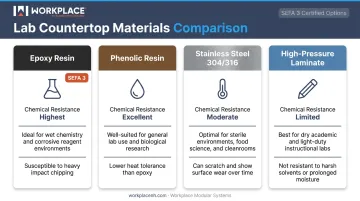
Workplace Modular Systems offers all four options, including 1-inch thick epoxy resin surfaces with drip grooves and chamfer edges, and Type 304 stainless steel with a #4 polished finish — both selected based on the specific chemical and temperature exposure of the application.
One important note: SEFA 7 governs laboratory fixtures and fittings, not bench surface performance. Work surface chemical resistance falls under SEFA 3 — make sure specifications reference the correct standard.
Ergonomics and Dimensional Specifications
OSHA states that ergonomics helps lessen muscle fatigue, increase productivity, and reduce the number and severity of work-related musculoskeletal disorders. For lab workers spending hours at a bench, the dimensional specs are not administrative details — they directly affect precision and endurance.
Verified height benchmarks (per Berkeley Laboratory Ergonomic Design Guidelines):
- Adjustable sitting/write-up stations: 22–32 inches
- Fixed sitting/write-up height: 28.5 inches
- Standard standing lab counter: 36 inches
- Minimum bench depth for microscopy, monitors, or laptops: 24 inches
- Wall bench depth (UC guidance): 30 inches
Height-adjustable benches are strongly recommended when multiple users share a station or when tasks alternate between seated and standing work. Workplace's Standard Workstation platform offers manual adjustment from 30" to 37", while the Direct Drive® motorized system provides 14 inches of travel for seamless sit-to-stand transitions — particularly useful in multi-researcher lab environments.

OSHA's lab ergonomics guidance also specifies providing sufficient leg room and ensuring knees do not contact the bench underside — a detail that affects base design, not just surface height.
Workflow and Layout Configuration
A misaligned layout increases transit time between steps, raises cross-contamination risk, and creates traffic bottlenecks. The goal is to minimize unnecessary movement while keeping related tasks physically adjacent.
Three primary layout types:
- Linear/wall-mounted — best for small analytical labs, utilities-intensive setups, or teaching environments where benches run along perimeter walls
- Peninsula/island — supports collaborative R&D, shared access from multiple sides, and instrument-heavy work zones
- Modular cluster — suited to dynamic facilities where team sizes change, new instruments are added, or research methods evolve frequently
Zoning is the underlying planning principle: separate preparation, analysis, and storage areas so that traffic flow through one zone doesn't interrupt another. Per UC Laboratory Safety Design Guide, adjacent bench aisle spacing should be 5 feet minimum, with 6 feet recommended in teaching labs.
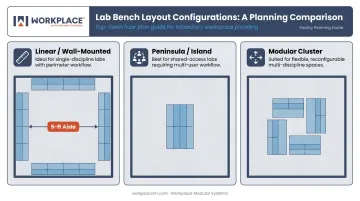
One practical consideration: fume hood openings should not be placed opposite desk-type work areas, and neither fume hoods nor biosafety cabinets should be positioned near doors, air registers, or high-traffic paths where airflow disruption undermines containment.
Storage and Organization Design
Inadequate storage is one of the most common workbench design failures. When researchers have nowhere to put things, items end up on the work surface — creating clutter that increases contamination risk, raises spill likelihood, and slows every task.
Integrated storage options to plan at the design stage:
- Under-bench drawers and cabinets for frequently used tools and consumables
- Overhead shelving for items needed at arm's reach but off the work surface
- Reagent racks and pegboards for vertical organization without consuming bench space
- Dedicated locked or ventilated cabinets for hazardous materials — these cannot be treated as afterthoughts
The placement rule: most-used items within arm's reach, hazardous materials in dedicated storage that meets chemical hygiene requirements under OSHA 29 CFR 1910.1450.
Workplace's modular storage systems include Mobile-Mate cabinets that can be repositioned as workflows change, fixed riser shelf assemblies with integrated power options, and vacuum pump enclosures for analytical lab configurations — all components that can be added to an existing workstation without replacing the frame.
Utility and Technology Integration
Power, gas, vacuum, water, and data connectivity must be designed into the workbench before installation — retrofitting them later disrupts active operations and typically produces cable and hose runs that create trip and contamination hazards.
Planning considerations by utility type:
- Electrical: 20 Amp/120V outlets as a baseline; dedicated circuits for high-draw instruments like LC-MS or ICP-MS systems
- Gas and vacuum: Lines run along bench backs or through vertical utility chases; cutout panels for specialty gas valves
- Drainage: Wet bench applications require drainage designed to local codes and chemical compatibility requirements
- Data/network: Keystone data jacks for instruments running digitally integrated workflows; overhead service panels for ceiling-routed connections
Workplace's StandardPlus platform integrates vertical utility chases directly into the leg design, reaching 80 inches total height — accommodating power, data, and specialty gas overhead while keeping the work surface unobstructed.
Modularity and Future-Proofing
Research programs evolve. New instruments arrive, teams grow or shrink, and protocols change. Fixed casework that can't be reconfigured often forces a full renovation when workflows shift.
According to Lab Design News, the cost difference between fixed and modular approaches is substantial:
- Fixed lab renovation: $300–$500 per square foot and 4–8 weeks of downtime
- Mobile bench reconfiguration: 2–4 hours with no external labor cost
- Modular upfront premium: 15–20% over fixed casework — typically recovered within 3–5 years at normal lab churn rates
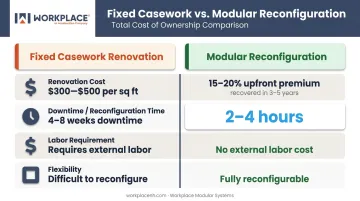
Workplace's component library spans more than 15,000 parts that can be combined, modified, and added to existing configurations years after the original order. Customers like Vertex and LabShares have had their original 4500 series platforms upgraded — adding 20-amp power strips, adjustable shelving, and specialized storage — without replacing the underlying frame.
Safety Compliance and Hazard Control
Every lab has specific hazard categories — chemical splash, electrostatic discharge, fire risk, biological contamination — and workbench design must address them explicitly, not by default.
Key compliance references:
- SEFA 3 — work surface chemical resistance standards
- OSHA 29 CFR 1910.1450 — chemical hygiene requirements for labs using hazardous chemicals
- BMBL 6th Edition — biosafety design requirements including bench surface properties (BSL-1/2 benchtops must be impervious to water and resistant to heat, organic solvents, acids, and alkalis)
- ANSI/ESD S20.20 and IEC 61340-5-1 — ESD control programs for electronics and sensitive instrumentation environments
The BMBL also specifies that spaces between benches, cabinets, and equipment at BSL-3 must be accessible for cleaning — a spatial constraint that affects bench placement and aisle width, not just surface choice.
How Workplace Modular Systems Can Help
Workplace Modular Systems has been manufacturing laboratory workbenches and modular workstations for over 65 years, serving pharmaceutical companies, life sciences organizations, clinical labs, and R&D facilities across the United States. Customers include Biogen, Vertex, Pfizer, Thermo Fisher Scientific, and Tampa General Hospital, among others.
Their process starts with a straightforward question: what are you doing in this space? From there, Design Specialists map the customer's workflow before any specification is written — identifying task sequences, utility requirements, chemical exposures, and spatial constraints that should drive the design, not the catalog.
What distinguishes their approach:
- All metal fabrication, welding, powder coating, and assembly done in-house at a 90,000 sq ft Londonderry, NH facility — no offshore supply chain exposure
- A modular parts library of 15,000+ components lets labs add shelving, storage, or utilities and reconfigure bench dimensions years after installation
- Surface materials — epoxy resin, phenolic resin, Type 304/316 stainless steel, and ESD laminate — are selected to match each lab's actual chemical and task profile
- Height-adjustable options range from manual 30"–37" to motorized Direct Drive® systems with 14 inches of travel
- Quick Ship on popular configurations ships in under 14 days; standard custom orders deliver in 30–45 days, with white-glove installation available
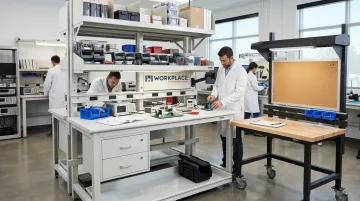
That modularity translates directly to real projects. For Actnano, standard 4500 series workstation frames were modified with shorter legs, notched work surfaces for uprights, epoxy pegboards, and upright-mounted turrets for nitrogen, compressed air, and vacuum — all drawn from standard components, configured around an actual workflow.
Conclusion
Effective laboratory workbench design comes down to alignment: every choice — from surface material to utility routing — should reflect the actual tasks, hazards, and growth trajectory of the lab. A higher price tag or a well-stocked catalog page doesn't guarantee the right fit. Workflow analysis does.
Involving facility planners, safety officers, and end-users in the specification process consistently produces better outcomes than selecting from a catalog without workflow analysis. The people who work at the bench every day know where the friction points are — that knowledge should drive the design.
Workbench design isn't a one-time event. As research programs evolve, workstations need to stay aligned with current workflows, new instruments, and updated safety requirements. Keeping that review manageable comes down to three practical decisions made upfront:
- Choose modular systems that can be reconfigured without full replacement
- Document the original design rationale so future changes have a clear baseline
- Schedule periodic reviews tied to major program shifts, not just equipment failures
Workplace Modular Systems works with lab directors, facility planners, and operations teams to configure workstations that hold up through those changes — built in-house in Londonderry, NH, and designed around how the lab actually runs.
Frequently Asked Questions
What is the best layout for a laboratory?
The best layout depends on the workflow. Linear/wall-mounted layouts suit small analytical or teaching labs; island layouts support collaborative R&D with shared instrument access; modular clusters work best for dynamic, multi-method facilities. The goal across all three is to minimize unnecessary movement between task zones.
How tall and deep should a lab workbench be?
Seated work surfaces range from 22–32 inches (adjustable) or a fixed 28.5 inches; standing counters sit at 36 inches. Bench depth starts at 24 inches for microscopy or monitor use, with wall benches typically at 30 inches. Height-adjustable benches are the right call when multiple users or mixed postures are involved.
What surface material is best for a laboratory workbench?
It depends on chemical exposure. Epoxy resin handles aggressive chemistry, phenolic resin suits wet biology labs, stainless steel works for sterile or high-heat environments, and laminate is appropriate for low-chemical educational settings. Match the material to the actual reagents and temperatures present — not to aesthetics or cost alone.
What is the difference between modular and fixed laboratory workbenches?
Fixed casework is permanently installed and difficult to reconfigure without demolition and MEP rework. Modular workbenches use standardized, interchangeable components that can be rearranged, expanded, or reconfigured as lab needs change — making them more cost-effective over a lab's full lifecycle.
How should utilities like power and gas be integrated into a lab workbench?
Utilities must be planned before furniture is installed. Gas and vacuum lines run along bench backs or through vertical utility chases; power outlets need dedicated circuits where load demands require it; drainage must meet local codes and chemical compatibility requirements. Retrofitting post-installation is far more disruptive and costly than planning upfront.
How often should laboratory workbenches be inspected or replaced?
Daily cleaning, periodic surface inspections for chemical damage, and an annual professional review are a practical starting point. With modular benches, individual components — surfaces, drawers, shelving — can be swapped out without replacing the entire workstation, extending service life considerably.