

For procurement managers and lab directors, these choices compound over time. Poor workstation decisions affect researcher safety, equipment compatibility, ergonomic health, and budget efficiency across multi-year cycles. Getting it right from the start is far cheaper than retrofitting or replacing furniture mid-grant.
This guide covers everything you need to know: how to define purpose-built engineering workstations, why university labs have unique infrastructure demands, and the six specification factors that determine long-term performance.
TL;DR
- Balance durability with flexibility — workstations must resist chemicals and ESD while staying reconfigurable as research programs shift
- Surface material is the most consequential spec — choose by discipline: ESD laminate, epoxy resin, phenolic resin, or stainless steel
- Load ratings vary significantly — SEFA table static tests use 600 lb minimum; heavy-duty benches can rate up to 1,500 lb or more
- Modular systems let you phase procurement around grant disbursement cycles — no lump-sum replacement required
- Verify SEFA 8 and OSHA compliance requirements before procurement, not after
What Are Engineering Workstations for University Research Labs?
Engineering workstations in this context are purpose-built, heavy-duty work surfaces and support structures designed to house instruments, support hands-on experimentation, and accommodate the physical and technical demands of engineering research. The specifications that distinguish them from standard office furniture matter more than they might appear — especially when instrument accuracy, researcher safety, or compliance are at stake.
SEFA 8M-2016 defines laboratory-grade metal casework, work surfaces, tables, and shelving as systems "specifically designed and manufactured" for laboratories — a meaningful distinction when evaluating suppliers.
Types Used in University Engineering Labs
Most modern university engineering labs use a combination of these four types:
- Fixed benches — maximum stability for vibration-sensitive instruments like balances and spectrometers; not reconfigurable
- Height-adjustable/ergonomic benches — essential for mixed-use spaces and long research sessions; accommodates varied user heights
- Modular workstations — built from interchangeable components, reconfigurable as research projects evolve
- ESD-rated workstations — required for electronics, PCB assembly, and semiconductor work; must meet ANSI/ESD S20.20 or IEC 61340-5-1
Choosing between these types starts with understanding your primary research disciplines, how often those disciplines shift, and whether multiple user groups share the same lab space.
Why University Engineering Labs Need Purpose-Built Workstations
University engineering research labs serve a distinctly complex role: supporting undergraduate teaching in the morning and graduate-level or faculty-led research in the afternoon, often in the same room. That dual-purpose demand places stress on workstation infrastructure that generic furniture simply cannot absorb.
High User Turnover and Variable Skill Levels
University labs cycle through dozens of different users weekly — undergraduates, graduate researchers, visiting faculty — each with different physical dimensions, work styles, and equipment requirements.
The consequences of ignoring this reality are documented. A 2024 study published in Frontiers in Public Health found that 58.9% of 241 laboratory professionals reported work-related musculoskeletal disorders over 12 months. More telling: 80.1% of lab bench stations were rated poor for safety or adequacy, and only 41% of workstation heights were correctly adjusted for their users.
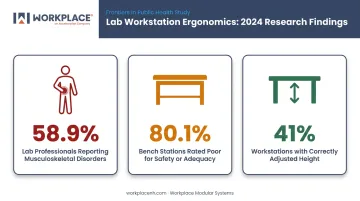
In shared university labs, where no single user "owns" a bench, height adjustability is a basic safety requirement — not an optional upgrade.
Diverse Research Disciplines in One Space
Engineering departments frequently consolidate multiple disciplines (mechanical, electrical, biomedical, materials science) into shared lab spaces. A workstation configured for circuit board assembly may be entirely inadequate for chemical synthesis or materials testing.
Institutions like Georgia Tech, MIT (with more than 40 makerspaces), and the University of Michigan's nearly 25,000 sq ft Wilson Student Team Project Center show that multi-discipline lab spaces are now the norm. That scale demands modular systems where surface materials, accessories, and configurations can be swapped without replacing entire units.
Evolving Research Priorities
NSF encourages funding durations of 3–5 years; NIH R01 grants typically run 1–5 budget periods. Research focus shifts with new grants, faculty hires, and curriculum changes on those same timelines.
According to the Whole Building Design Guide, academic institutions change 5–10% of lab layouts annually. Fixed, welded workstation systems become expensive liabilities when priorities shift. Reconfigurable, modular systems protect that capital investment by enabling:
- Surface and work top swaps without replacing structural frames
- Accessory additions (shelving, power rails, monitor arms) as research needs change
- Full reconfiguration across disciplines without procurement delays
Key Factors to Consider When Choosing Engineering Lab Workstations
Choosing the right engineering workstation means connecting physical specifications to research outcomes. These six factors directly determine how well a workstation performs under academic engineering lab conditions.
Work Surface Material and Chemical Resistance
Surface material is the most critical decision. The wrong choice degrades under chemical exposure, creates contamination risks, or fails to protect sensitive instruments.
| Material | Best For | Key Limitation |
|---|---|---|
| Epoxy resin | Chemistry, wet labs, heavy chemical use | Susceptible to scratching from extended spills |
| Phenolic resin | General engineering, workshops | Less heat resistance than epoxy |
| Stainless steel (Type 304) | Sterile environments, pharmaceutical, cleanrooms | Higher cost; verify compatibility with chlorides/acids |
| ESD laminate | Electronics, PCB assembly, semiconductor work | Not inherently chemical-resistant — verify separately |
SEFA 3 documents chemical resistance for each material type. Require material-specific documentation from any supplier — don't assume one surface covers all lab activities.
Load Capacity and Structural Integrity
Engineering labs frequently house heavy analytical instruments. ICP-MS systems from Agilent and PerkinElmer list instrument weights of 90–150 kg; that alone can exceed accessory shelf ratings on undersized benches.
Load ratings aren't a single benchmark — they vary significantly by configuration:
- SEFA 8M table static test minimum: 600 lb evenly distributed
- Standard workstation (stationary or mobile): typically 500–750 lb depending on leg configuration
- Heavy-duty engineering benches: 1,500 lb evenly distributed
- Research and analytical lab workstations (for mass spectrometry): 1,000 lb
- Accessory shelves: 75–200 lb depending on type
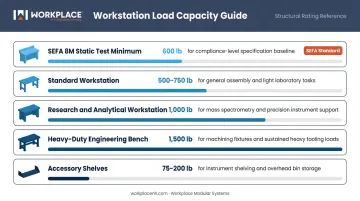
Always specify both static bench load and shelf load ratings separately when procuring for instrument-heavy environments.
Ergonomic Design and Adjustability
Long research sessions — often 4–8 hours — at improperly designed workstations generate fatigue and musculoskeletal issues that reduce output. Yet ergonomic fit is rarely specified correctly at procurement.
UNC's Environmental Health and Safety guidance specifies that precision work requires a higher surface to reduce bending, while heavy work should sit approximately 6 inches below elbow height. In a shared lab where users range from 5'2" to 6'3", a single fixed bench height works for almost no one.
What to specify:
- Height-adjustable range — manual adjustment from 30"–37" covers most users; motorized direct drive systems with 14" of travel accommodate a wider range
- Surface depth — adequate reach to instruments without awkward posture
- Ergonomic seating compatibility — particularly for precision tasks requiring sustained focus and fine motor control
Cable Management and Utility Integration
Engineering research generates significant utility complexity: power outlets, data ports, gas lines, vacuum lines, and compressed air are all routine requirements. Disorganized cable runs also create direct compliance exposure.
OSHA 1910.305 requires flexible cords and cables to be protected from accidental damage. OSHA 1910.334 requires visual inspection of portable cord-and-plug equipment before each shift. Cords running across pathways violate OSHA laboratory safety guidance directly.
Specify these at procurement to avoid costly retrofits later:
- Integrated cable raceways or cord troughs (3"x3" mounted to frame or beneath the unit)
- Overhead utility carriers with knockouts for power, data, and gas fittings
- Built-in power strips with circuit breakers (15A or 20A depending on equipment load)
- Vertical utility chases for labs needing overhead service panel integration
- Pre-configured data port integration via Keystone jacks
Modularity and Reconfigurability
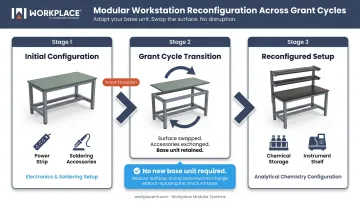
Modular workstation systems — built from interchangeable components rather than welded assemblies — allow a lab to reconfigure its layout as research programs evolve. With NIH and NSF grant cycles running 3–5 years, this matters directly.
Modularity also enables phased procurement: a department can start with a core workstation and add overhead shelving, power strips, monitor arms, and storage drawers in subsequent budget cycles. This aligns capital spending with grant disbursement rather than requiring full upfront investment.
A practical example: a lab bench configured for soldering and electronics work today can have its surface, accessories, and utility panels swapped to support analytical chemistry instrumentation in the next grant cycle — without purchasing a new base unit.
Safety and Compliance Standards
Modularity and load specs mean nothing if the workstation fails a compliance audit. Verify these standards before finalizing any procurement:
- SEFA 8M — laboratory-grade metal casework, structural load tests, and chemical spot resistance for work surfaces
- SEFA 10 — adaptable laboratory furniture systems with modular structures and utility integration
- OSHA 1910 Subpart S — electrical safety including cord routing and equipment inspection
- ANSI/ESD S20.20 / IEC 61340-5-1 — required for any ESD workstation in electronics labs
Request compliance documentation from suppliers during procurement, not after delivery. Verified SEFA certification and ESD compliance packages should be standard deliverables.
How Workplace Modular Systems Can Help
Workplace Modular Systems has been manufacturing purpose-built workstations for over 65 years, serving clients in clinical life sciences, R&D engineering, pharmaceutical labs, and biomedical production — environments whose demands closely mirror those of university engineering research labs.
The company's product line covers the full range of configurations relevant to university labs:
- Standard and StandardPlus workstations with vertical utility chases, integrated power, and data connectivity
- Direct Drive height-adjustable workstations with 14" of motorized travel and 500–750 lb static load capacity
- Heavy-duty benches rated to 1,500 lb for instrument-intensive environments
- Research and analytical lab workstations with 1,000 lb load ratings, SEFA 8-compliant chemical-resistant surfaces, and vibration-dampening frames
- Custom ESD workstation systems certified to ANSI/ESD S20.20 and IEC 61340-5-1
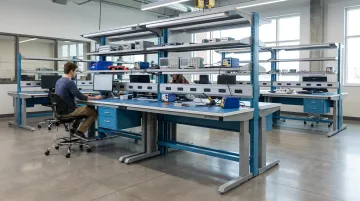
Documented university applications include an Electrical Engineering Department installation using an L-shaped heavy-duty configuration as a soldering station, and an Environmental Engineering Department instrumentation room housing gas chromatography and ion exchange apparatus.
That track record translates directly into practical delivery terms. All products are manufactured domestically in Londonderry, NH, with standard custom orders shipping in 30–45 days and Quick Ship configurations available in under 14 days for popular setups.
The modular architecture means accessories can be added or removed at any time, a core advantage for labs managing phased budgets.
Workplace's consultative approach starts with a single question: what are you doing in this space? From there, Design Specialists provide complimentary engineered drawings and layout plans before any order is placed. Contact Workplace Modular Systems at 800.258.9700 or sales@workplacenh.com to begin a lab assessment.
Conclusion
Equipping a university engineering research lab is a long-term infrastructure decision. The right workstation directly supports researcher safety, experimental accuracy, and the lab's capacity to adapt to future funding and research directions.
Start with a clear needs assessment: research disciplines, user count, equipment load, utility requirements, and applicable safety standards. Match those requirements to workstation specifications. Revisit that alignment whenever the lab's research mandate shifts — and in active research environments, it will.
Before finalizing any procurement decision, confirm your specifications cover:
- Load and utility requirements — weight capacity, electrical, plumbing, and ventilation needs per station
- Safety and compliance standards — OSHA, NFPA, and discipline-specific regulatory requirements
- Reconfigurability — whether the workstation can adapt as research focus or team size changes
Manufacturers like Workplace Modular Systems offer custom-configured lab workstations built to these exact specifications, with standard lead times of 30–45 days for custom orders. Getting the specs right upfront avoids costly retrofits later.
Frequently Asked Questions
What is the difference between a fixed and modular engineering workstation for a university lab?
Fixed benches offer maximum stability for vibration-sensitive instruments but cannot be reconfigured once installed. Modular systems use interchangeable components — surfaces, uprights, accessories, utilities — that can be rearranged as needs evolve. For most university labs where research programs and equipment change regularly, modular is the better long-term investment.
What work surface material is best for engineering research labs?
The best material depends on the discipline: ESD laminate for electronics and PCB work, epoxy resin for chemistry or wet labs, phenolic resin for general-purpose engineering and workshops, and Type 304 stainless steel for sterile or high-heat environments. Most multi-discipline labs use different surface types across different zones rather than one material throughout.
How much weight capacity should engineering lab workstations support?
SEFA 8M sets the static test minimum at 600 lb evenly distributed, but heavy analytical instruments like ICP-MS systems can weigh 90–150 kg each. Heavy-duty benches typically rate at 1,500 lb for distributed loads; research workstations commonly rate at 1,000 lb. Always verify bench load and accessory shelf ratings separately before procurement.
How do ergonomic workstations improve productivity in university research labs?
Height-adjustable workstations reduce fatigue during long research sessions, lower repetitive strain injury risk, and accommodate users across a wide range of physical dimensions. With over 58% of lab professionals reporting musculoskeletal disorders and 80% of bench stations rated poor for ergonomic adequacy, adjustability is a direct productivity and retention issue — not an optional upgrade.
What safety standards should engineering workstations in university labs meet?
Key applicable standards include:
- SEFA 8M — structural and chemical resistance performance for laboratory furniture
- SEFA 10 — adaptable and modular laboratory systems
- OSHA 1910 Subpart S — electrical safety and cord management
- ANSI/ESD S20.20 / IEC 61340-5-1 — ESD control for electronics lab applications
Request formal compliance documentation from suppliers during procurement.
How long does it take to procure and install custom engineering workstations for a university lab?
Standard custom configurations typically ship in 30–45 days; specialized casework can run 8–12 weeks. Quick Ship programs deliver popular configurations in under 14 days. Begin procurement well ahead of semester start dates or grant deadlines — late installations are hard to recover from once a research program is underway.