This guide cuts through the complexity. You'll find steel-specific specs (gauge, construction, finish), a clear breakdown of painted versus stainless steel, the compliance standards that govern procurement, the correct CSI section for your spec documents, and layout principles that hold up in real project environments.
TL;DR
- 16-gauge structural components and 18-gauge cabinet bodies are standard in lab casework; specify gauge by component, not as a single blanket requirement
- SEFA 8M-2016 is the performance benchmark to require; vague "lab-grade" claims are not a substitute
- Painted powder-coat steel suits general labs; Grade 304 or 316 stainless is required for sterile, pharmaceutical, or clinical environments
- Steel casework falls under CSI Division 12, Section 12 35 53.13 in project spec documents
- Modular freestanding systems protect long-term investment when lab workflows or team sizes are likely to change
What Is Steel Laboratory Casework and Why Is It the Default Choice?
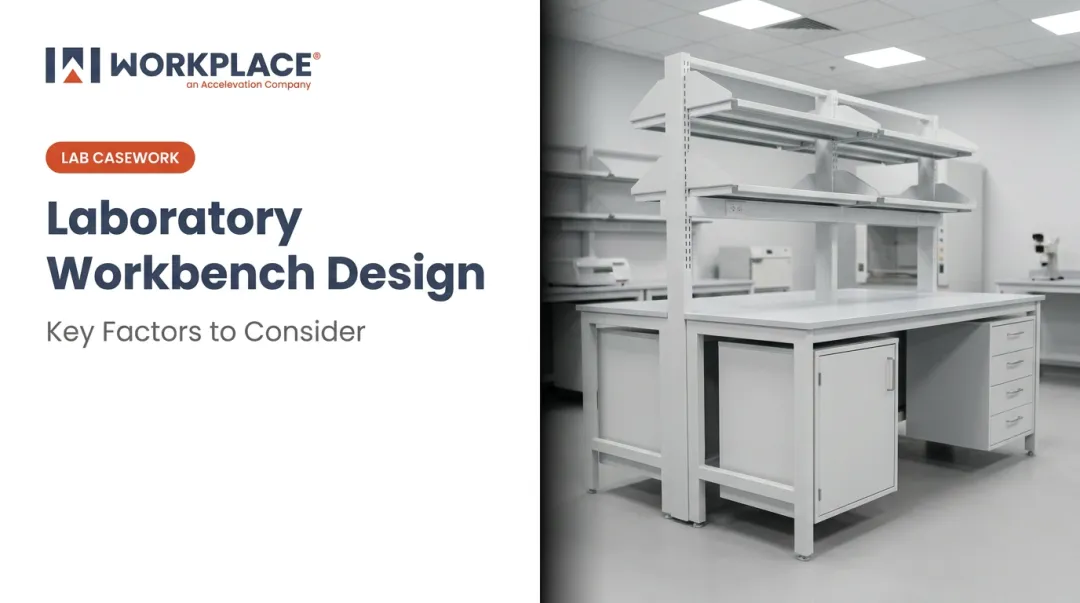
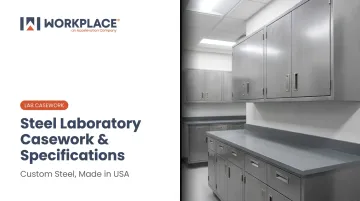
Steel laboratory casework is the integrated system of base cabinets, wall-hung units, overhead storage, and work surfaces fabricated from steel and purpose-built to meet the load, chemical, and safety demands of scientific environments. Unlike general commercial cabinetry, it's built to different dimensional tolerances, load ratings, and finish performance standards.
Labs default to steel for four concrete reasons:
- Non-combustible — a key consideration under local fire codes and NFPA standards
- Dimensionally stable — welded steel frames don't rack or warp under heavy instrument loads the way wood-based systems can
- Moisture and chemical resistant — powder-coat finishes tested against 49 reagents provide reliable protection in most lab environments
- Cost-effective — painted steel delivers durability at a lower initial cost than stainless, making it the baseline spec for most projects
The environments where steel casework dominates include university chemistry labs, industrial QC facilities, biomedical production spaces, pharmaceutical research labs, and government research facilities. That range of use cases reflects the material's genuine performance across load, finish, and durability requirements — which is why specifications sections below focus heavily on how those properties are measured and validated.
Understanding Steel Laboratory Casework Specifications
Getting specs right requires going beyond "steel casework" as a product category. The details below are what separate a defensible specification from one that gets substituted with inferior product during the bid process.
Gauge: Specify by Component, Not by a Single Number
The common shorthand — "16-gauge steel casework" — is incomplete. Published manufacturer specifications assign different gauges to different components based on structural role. Mott Manufacturing's specification uses 16-gauge for tubular rails and table legs, 18-gauge for door and drawer fronts and cabinet sides, and 20-gauge for drawer bodies and shelves. Kewaunee follows the same logic: 16-gauge for front rails and hinge reinforcements, 18-gauge for cabinet bodies.
The practical takeaway: write a component-level gauge schedule in your spec document, not a single number. Pair it with assembly-level load ratings because load capacity reflects the full engineered assembly, not gauge in isolation.
Workplace Modular Systems, for example, builds standard workstation platforms from 2" x 2" square 18-gauge furniture-grade steel tubing, with assembly ratings of 500 lbs static load for standard configurations and 1,500 lbs for heavy-duty platforms — ratings verified at the assembly level, not extrapolated from material specs alone.
Construction Method: Welded vs. Knock-Down
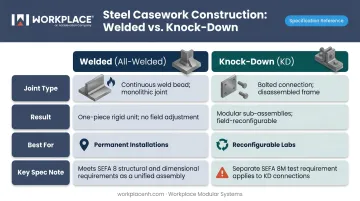
Two joint methods dominate steel lab casework, and your spec document must state which one is required:
| Welded (All-Welded) | Knock-Down (KD) | |
|---|---|---|
| Joint type | Electro spot-welded or continuously welded | Bolted or mechanical connections |
| Result | Rigid, one-piece unit | Disassemblable, relocatable |
| Best for | Permanent installations, instrument benches, dimensional-stability-critical environments | Labs expecting reconfiguration or future moves |
| Key spec note | Used by Mott, Kewaunee for standard casework lines | Require its own SEFA 8M test report — KD products don't inherit performance data from welded equivalents |
Finish: Powder Coat Thickness Plus Chemical Testing
SEFA 8M-2016 runs chemical resistance testing on 2 to 4 mil finished 18-gauge cold-rolled steel samples, exposing them to 49 reagents with acceptance criteria of no more than four Level 3 deterioration conditions.
Hamilton Laboratory Solutions specifies 1.5 mil average / 1.2 mil minimum dry-film thickness on exposed surfaces. Kewaunee adds mechanical tests on top of chemical resistance:
- ASTM D522 bend over a 1/2-inch mandrel
- 1 lb ball drop from 12 inches
- 4H pencil hardness
- Adhesion testing
Specify both: dry-film thickness and chemical test acceptance criteria. Thickness alone overstates protection if the pretreatment and cure process aren't also documented.
Hardware: Drawer Slides and Door Testing
Hardware specs are where many procurement documents fall short. For drawer slides, verified lab casework ratings include 100 lb full-extension slides (Kewaunee standard, Workplace standard) and 200 lb options for heavier-duty configurations.
SEFA 8M-2016 hardware tests validate these ratings through:
- Drawer static load: 150 lb hung from drawer head for 5 minutes
- Drawer impact: 10 lb bag dropped 24 inches into drawer bottom
- Drawer cycle test: 50,000 cycles at 100 lb (lab load) or 150 lb (heavy-duty load)
- Door cycle test: 100,000 cycles per ANSI A156.9 Grade 1 procedure
- Door static load: 200 lb applied 12 inches from hinge centerline
Match slide ratings to actual expected load profiles, and require SEFA 8M test evidence rather than relying on a manufacturer's stated capacity alone.
Workplace Modular Systems' lab casework uses full-extension, all-steel ball-bearing drawer slides with minimal sideplay. For load ratings on specific configurations, their design specialists can provide documentation at 800.258.9700.
Painted Steel vs. Stainless Steel Lab Casework
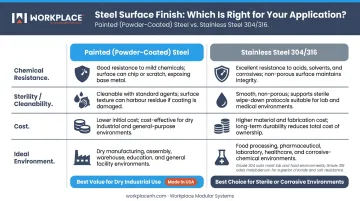
Painted (Powder-Coated) Steel
Powder-coated steel is the workhorse of laboratory casework: strong, SEFA-tested, and available in standard and custom configurations. It suits general-purpose labs, industrial QC environments, and educational facilities well.
The limitation is environment. Highly corrosive chemical exposure, sterile manufacturing workflows, and spaces requiring repeated sanitization with harsh disinfectants will eventually degrade powder-coat finishes — even quality ones.
Stainless Steel
Stainless steel's non-porous surface can withstand repeated sterilization, harsh disinfectants, and a broad range of aggressive chemicals — which is why it's the required spec for pharmaceutical manufacturing, biomedical research, cleanroom, and clinical diagnostic environments.
Two grades cover most lab applications:
- Grade 304 — standard for lab casework where corrosion resistance and cleanability are needed but chloride exposure isn't severe
- Grade 316 — adds 2–3% molybdenum for improved resistance to chloride attack and pitting; costs more than 304 and is warranted specifically where the chemistry includes chlorinated compounds, saltwater, or aggressive halide-containing disinfectants
Specify 316 only when the chemical environment justifies the added cost.
Side-by-Side Comparison
| Criterion | Painted Steel | Stainless Steel (304/316) |
|---|---|---|
| Chemical resistance | Good — 49-reagent SEFA test | Excellent — broad chemical range |
| Sterility / cleanability | Adequate for routine wipedown | Superior; withstands repeated sterilization |
| Cost | Lower initial cost | Higher; 316 costs more than 304 |
| Ideal environment | General labs, education, industrial QC | Pharma, biomedical, cleanroom, clinical |
One more specification to keep distinct: countertop material is a separate call from casework material.
Countertop Materials
Cabinet bodies are almost always paired with a dedicated work surface. Common options include:
- Epoxy resin — heavy chemical use, heat and scratch resistance
- Phenolic resin — moisture-heavy environments, research and pharmaceutical labs
- Stainless steel tops — sterile protocols, wet lab work
Write casework and countertop specs as separate line items in your project documents.
Compliance Standards That Govern Steel Lab Casework
SEFA 8M: The Performance Benchmark
SEFA 8M-2016 from the Scientific Equipment and Furniture Association is the primary performance standard for metal laboratory casework. "SEFA 8 compliant" on a spec sheet means the product has been tested against specific quantitative criteria — not simply that a manufacturer claims it meets lab-grade requirements.
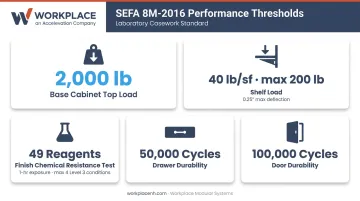
Key test thresholds to know:
- Base cabinet top load: 2,000 lb
- Shelf load: 40 lb/sf, maximum 200 lb, maximum deflection 1/180 of span or 0.25 inch
- Finish chemical test: 49 reagents, 1-hour exposure, no more than four Level 3 conditions
- Drawer cycles: 50,000 at rated load
- Door cycles: 100,000
Require SEFA 8M test reports — third-party documentation — not a manufacturer self-declaration.
OSHA: Flammable Storage, Not Every Base Cabinet
OSHA 29 CFR 1910.106 governs flammable-liquid storage cabinets. Key requirements: maximum 60 gallons of Category 1, 2, or 3 flammable liquids per cabinet, 18-gauge double-wall metal construction with a 1-1/2 inch air space, a 2-inch sill, and a "Flammable – Keep Fire Away" label. These requirements apply to dedicated flammable storage cabinets — not to standard lab base cabinets.
OSHA 29 CFR 1910.1450 requires a written Chemical Hygiene Plan for laboratory chemical hazards, which drives storage zoning and labeling decisions that feed directly into the casework layout.
ADA Accessibility Requirements
ADA standards set specific dimensional requirements for accessible work surfaces:
- Work surface height: 28 to 34 inches
- Clear floor space: 30 x 48 inches
- Knee and toe clearance: per Section 306
- Accessible route width: 36 inches minimum
Height-adjustable steel base frames are one approach to meeting these dimensions, but they don't replace verifying the full layout against ADA requirements during design. For reference, Workplace Modular Systems offers manual height-adjustable workstations with a 30" to 37" range (7 positions) and motorized Direct Drive systems with 14 inches of travel — both configurable for ADA-compliant setups.
Fire and Building Codes
Steel's non-combustible nature is frequently relevant under IBC and NFPA 45 provisions. NFPA 45 covers fire protection for laboratories using chemicals. Architects and facility planners should verify applicable IBC noncombustible material requirements and NFPA 45 provisions for their specific project. Confirming compliance falls under code coordination with the project architect or authority having jurisdiction (AHJ), not the casework product spec sheet.
Specifying Steel Casework: The CSI Section and What to Include
The Right MasterFormat Section
In the CSI MasterFormat system, laboratory casework is specified under Division 12 (Furnishings), specifically Section 12 35 53.13 – Metal Laboratory Casework for steel installations. Some project documents use the parent section 12 35 53 – Laboratory Casework when covering multiple materials. Built-in casework integrated with architecture may appear in Division 06 on some projects — confirm with the project architect.
What Belongs in the Spec Section
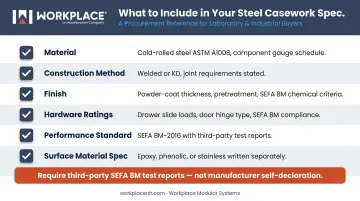
A complete steel casework spec prevents substitution of lower-quality product during bidding. Include:
- Material: Cold-rolled steel per ASTM A1008/A1008M, with a component-level gauge schedule
- Construction method: Welded (specify continuously welded or spot-welded joints) or KD, with joint requirements stated
- Finish: Powder-coat type, dry-film thickness (minimum and average mils), pretreatment process, and SEFA 8M chemical test acceptance criteria
- Hardware ratings: Drawer slide load ratings, door hinge type, and SEFA 8M hardware test compliance
- Performance standard: SEFA 8M-2016 compliance with third-party test reports required
- Surface material spec: Written separately — epoxy resin, phenolic resin, or stainless, as applicable
Practical Procurement Considerations
Spec decisions made on paper have real downstream consequences. Standard painted steel configurations typically carry 30–45 day lead times for custom orders. Workplace Modular Systems' Quick Ship program delivers popular steel workstation configurations in under 14 days. Custom-gauge or non-standard finish configurations require consultation to confirm timelines.
Include approved-equals language in the spec to control substitution, and specify that any equals submission must include SEFA 8M test reports for the proposed product — not just the originally specified one.
Working with a manufacturer that handles fabrication in-house (cutting, welding, powder coating, and assembly under one roof) compresses the timeline from approved drawings to delivery and eliminates variability that comes with outsourced fabrication steps.
Steel Casework Layout and Configuration Principles
Standard Layout Configurations
Three configurations cover the majority of lab casework installations:
- Perimeter layout — casework along walls, open center floor space. Best for individual work, maximizes circulation, and is the most common configuration for general research labs
- Island layout — central bench runs with open aisles on both sides. Suited for collaborative work, high-throughput processes, and shared instrumentation
- Peninsula layout — casework extending from a wall into the room, creating defined zones. Useful for separating workflow stages or accommodating a mix of individual and shared work areas
Workflow determines the right choice. The key planning principle: sequence workstations to mirror the actual lab process flow — sample receiving to prep to analysis to storage — rather than defaulting to a layout because it fills the room efficiently.
Fixed vs. Modular Systems
Fixed casework — welded or anchored to the structure — provides maximum stability and suits permanent, well-defined processes where reconfiguration is never expected.
Modular freestanding steel casework allows labs to reconfigure as workflows, equipment, or team sizes change. Workplace Modular Systems' modular lab workstations are built on standardized frames where any accessory can be removed or added after installation — shelving, storage cases, power strips, and overhead components all reposition without structural modification. For labs anticipating growth or process changes, specifying modular from the outset avoids costly reconfiguration later.
Utility Integration
Once the system type is set, utility routing is the next decision to lock in — before casework is ordered, not after. Coordination options include:
- Vertical utility chases integrated into workstation legs (routing power, data, and gas from floor to overhead)
- Overhead service panels for electrical, data, air, and gas accessed from above — 16-gauge panels designed to fit standard ceiling grids
- Powertroughs and airtroughs mounted along the bench for surface-level utility access
Getting this sequence right keeps bench surfaces clear, eliminates trip hazards, and removes the expensive field modifications that follow when utilities are resolved as an afterthought.
Frequently Asked Questions
What spec section is casework?
Laboratory casework is typically specified under CSI MasterFormat Division 12, Section 12 35 53.13 – Metal Laboratory Casework for steel installations. Built-in casework integrated with architectural millwork may fall under Division 06 on some project documents — confirm with the project architect of record.
What is the recommended layout for a laboratory?
The best layout depends on workflow. Perimeter layouts maximize open floor space and suit individual work; island layouts work for collaborative or high-volume processes. The governing principle is to sequence workstations to match the lab's actual process flow, from intake through analysis to storage.
What gauge steel is best for laboratory casework?
16-gauge is standard for structural components like rails and legs; 18-gauge is typical for cabinet bodies, doors, and drawer fronts. Specify a component-level gauge schedule rather than a single number, and require assembly-level SEFA 8M load test results to confirm actual capacity.
What is the difference between painted steel and stainless steel lab casework?
Painted (powder-coated) steel is cost-effective for general labs with moderate chemical exposure. Stainless steel — Grade 304 or 316 — is required for sterile, pharmaceutical, or clinical environments where the casework must withstand repeated sanitization with harsh disinfectants and broad chemical exposure.
What is SEFA 8 compliance and why does it matter?
SEFA 8M-2016 is the Scientific Equipment and Furniture Association's performance standard for metal lab casework, covering structural load testing, finish chemical resistance (49 reagents), and hardware durability (50,000 drawer cycles, 100,000 door cycles). Require SEFA 8M compliance with third-party test reports in your spec to confirm real-world performance.
Can steel laboratory casework be reconfigured after installation?
Modular freestanding steel casework — like the systems Workplace Modular Systems manufactures — can be relocated, reconfigured, and accessorized at any time, making it the right choice for labs anticipating growth or workflow changes. Fixed welded or anchored casework is permanent and cannot be adapted after installation.