Introduction
Labs in pharmaceutical, environmental, food safety, and forensic industries must identify and quantify complex chemical compounds with precision. The analytical tools they choose directly shape data quality, compliance outcomes, and lab throughput.
GC-MS (Gas Chromatography-Mass Spectrometry) sits at the center of modern analytical science. It combines the separation power of gas chromatography with the identification precision of mass spectrometry, delivering results that neither technique achieves alone. Pesticide residue screens, forensic drug confirmations, and residual solvent tests in pharma manufacturing all fall within its validated, regulatory-recognized scope.
The global mass spectrometry market reached USD $6.6 billion in 2025 and is projected to grow at 7.2% CAGR through 2030, according to MarketsandMarkets. GC-MS drives a substantial portion of that volume — embedded in EPA-regulated environmental testing, FDA pesticide methods, SAMHSA drug confirmation protocols, and ICH pharmaceutical guidelines.
This guide covers how GC-MS works, the system types available, its major industry applications, how it compares to other techniques, and what a well-configured GC-MS lab workspace actually requires.
TL;DR
- GC-MS separates volatile compounds by chromatography, then identifies them by their unique mass spectral fragmentation pattern
- The GC component handles separation; the MS component provides definitive identification via mass-to-charge (m/z) ratios
- Key applications span food safety, environmental monitoring, pharmaceuticals, forensics, and oil and gas
- Instrument configurations (single quadrupole, triple quadrupole, HRAM) are chosen based on the sensitivity and selectivity demands of each application
- GC-MS instruments are vibration-sensitive; lab workspace design — including bench stability and load capacity — directly affects data reliability
What Is GC-MS?
GC-MS is a hyphenated analytical technique that couples gas chromatography for separation with mass spectrometry for identification and quantitation. Neither instrument alone offers the same capability: GC separates but cannot definitively identify unknowns; MS identifies but requires separated, clean inputs to work accurately.
The Two Core Components
Gas Chromatograph: The prepared sample is vaporized and carried through a capillary column coated with a stationary phase. Compounds separate as they travel through the column at different rates, based on their boiling points and interactions with the stationary phase. Each compound exits at a unique retention time.
Mass Spectrometer: Eluted compounds enter the ion source, where they are ionized and fragmented. The resulting ions are separated by their mass-to-charge (m/z) ratio, producing a spectral fingerprint unique to each compound. As NIST describes it, EI (electron ionization) spectra function as molecular fingerprints. The As NIST describes it, EI (electron ionization) spectra function as molecular fingerprints. The NIST26 EI Library contains 431,277 EI spectra covering 382,180 compounds, enabling automated library-based identification.
What Samples Work Best
GC-MS is suited for volatile and semi-volatile organic compounds, including:
- Hydrocarbons and aromatics (BTEX compounds)
- Pesticides and herbicides
- Fatty acids and FAMEs
- Steroids and hormones (typically after derivatization)
- Alcohols, solvents, and VOCs
Solid, liquid, and gaseous samples can be analyzed with appropriate preparation. The output includes both a chromatogram (retention time data) and mass spectra (fragmentation patterns) — with compound confirmation requiring a match between both.
The right instrument configuration depends on your application. Here's how the main system types compare.
Types of GC-MS Systems
| System Type | Mode | Best For |
|---|---|---|
| Single quadrupole | Full scan / SIM | Routine targeted and untargeted screening — pesticides, VOCs, drugs of abuse |
| Triple quadrupole (GC-MS/MS) | SRM | Trace-level quantitation in complex matrices — food contaminants, environmental residues |
| HRAM (TOF / Orbitrap) | Full scan accurate mass | Non-targeted screening, unknown identification, metabolomics |
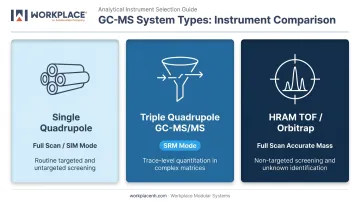
As Agilent notes, the single quadrupole is the most widely used GC/MS instrument type for routine laboratory work. Triple quadrupole systems operated in SRM mode reduce matrix interference significantly for targeted trace analysis. HRAM platforms (such as the Thermo Fisher Orbitrap Exploris GC) combine quantitation, screening, and confident unknown identification in a single run.
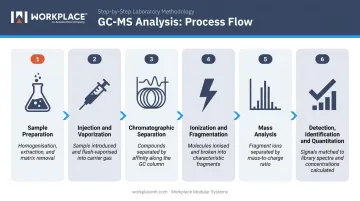
How GC-MS Analysis Works: Step by Step
Each stage in GC-MS analysis is a potential point of failure — or optimization. Knowing what happens at every step helps analysts troubleshoot faster, validate methods more confidently, and get cleaner data the first time.
Step 1 – Sample Preparation
Samples must be extracted from their matrix — food, soil, water, biological fluid — and cleaned up before injection. Common approaches include QuEChERS extraction for pesticide residues, liquid-liquid extraction, and solid-phase extraction. Automated robotic autosamplers can replace manual handling, reducing analyst variability and improving throughput in high-volume labs.
Step 2 – Injection and Vaporization
The prepared sample is injected into the GC inlet, where it vaporizes and is swept into the capillary column by an inert carrier gas (typically helium, though hydrogen and nitrogen are increasingly used as alternatives given helium supply constraints).
Step 3 – Chromatographic Separation
As the vaporized sample travels through the column, compounds partition between the mobile gas phase and the stationary phase coating the column wall. Compounds with lower boiling points or weaker stationary-phase interactions elute first. Each compound exits at a distinct retention time, forming the basis of the chromatogram.
Step 4 – Ionization and Fragmentation
Eluted compounds enter the mass spectrometer's ion source. Electron ionization (EI) — the most common method — bombards molecules with electrons, causing fragmentation into characteristic ion patterns. EI produces reproducible, library-searchable spectra. Chemical ionization (CI) is a softer alternative that preserves the molecular ion for molecular weight confirmation.
Step 5 – Mass Analysis
The mass analyzer separates ions by m/z ratio. Two primary acquisition modes exist:
- Full scan mode: Acquires spectra across a broad m/z range — ideal for unknown screening and library matching
- SIM (Selected Ion Monitoring): Monitors specific ions for higher sensitivity — preferred for targeted quantitation of known compounds
Step 6 – Detection, Identification, and Quantitation
Detected ions are plotted as a mass spectrum. Peak areas provide quantitation data. Software matches spectral patterns against mass spectral libraries for identification. Retention time plus spectral match together provide high-confidence compound confirmation — the dual-verification standard required for regulatory submissions and forensic defensibility that single-detector GC cannot achieve.
Key Applications of GC-MS Across Industries
GC-MS earns its place in regulated and research workflows alike because it handles two tasks at once: separating complex mixtures and identifying what's in them. The applications below reflect where that dual capability is non-negotiable.
Food and Beverage Safety
GC-MS and GC-MS/MS are central to pesticide residue monitoring. The FDA ORA Pesticides Analysis Manual uses a harmonized multi-residue method combining modified QuEChERS extraction with GC-MS/MS and LC-MS/MS detection for pesticide residues in food commodities. GC-MS is also used to detect flavor compounds, food adulterants, and packaging migrants.
Environmental Monitoring
Standardized EPA methods embed GC-MS directly into environmental compliance workflows:
- EPA Method 8260C : VOCs in solid waste, drinking water, and aqueous samples
- EPA Method 8270E : SVOCs including PAHs (naphthalene, anthracene, benzo[a]pyrene) in environmental matrices
- BTEX compounds (benzene, toluene, ethylbenzene, xylene) in contaminated water and soil
Pharmaceuticals and Forensics
- Residual solvent testing: ICH Q3C(R8) specifies chromatographic techniques such as gas chromatography for residual solvent determination; GC-MS workflows support USP 467 compliance in pharma manufacturing
- Forensic drug testing: HHS/SAMHSA Mandatory Guidelines require confirmatory drug tests to use mass spectrometric identification, with GC-MS, GC-MS/MS, LC-MS, or LC-MS/MS all accepted. Updated guidelines took effect February 1, 2024
- Anti-doping analysis: Steroid hormones including testosterone, DHT, estradiol, and progesterone are quantified by GC-MS/MS after derivatization
Oil, Gas, and Industrial Chemistry
GC-MS covers a broad range of petroleum and industrial applications:
- BTEX compound detection in petroleum-contaminated water and soil
- Refinery gas speciation and hydrocarbon profiling
- Battery electrolyte characterization
- Process line quality control, including identification of unexpected compounds
Research and Metabolomics
HRAM GC-MS systems are well-suited in metabolomics workflows, where untargeted profiling of biological samples demands both broad coverage and confident compound identification. Unlike quadrupole instruments, HRAM systems deliver accurate mass data — enabling molecular formula assignments that support deeper structural interpretation.
GC-MS vs. Other Analytical Techniques
GC-MS vs. GC Alone
A standard GC equipped with a flame ionization detector (FID) or thermal conductivity detector (TCD) provides separation and relative quantitation but cannot confirm compound identity. GC-MS adds the mass spectral fingerprinting layer that enables definitive identification — critical when unknown compounds appear in complex matrices or when regulatory confirmation is required.
GC-MS vs. LC-MS
The choice depends on compound properties:
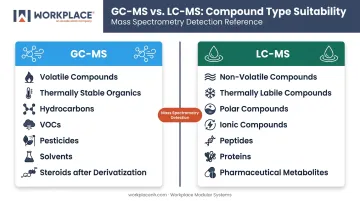
- GC-MS: Best for volatile, thermally stable, GC-amenable compounds — hydrocarbons, VOCs, pesticides, solvents, steroids after derivatization
- LC-MS: Better suited for non-volatile, thermally labile, large, polar, ionic, or high-molecular-weight compounds — peptides, proteins, many pharmaceutical metabolites
In practice, the two techniques cover different chemical spaces. Many labs run both — GC-MS for volatile organic analysis and LC-MS for biomolecules and polar compounds.
GC-MS vs. HPLC
HPLC separates compounds in solution but, without a mass spectrometer, relies on UV or other non-specific detectors that cannot confirm compound identity. GC-MS provides separation and spectral identification in one run. HPLC remains the preferred option for non-volatile, high-molecular-weight analytes where GC would require derivatization or proves technically unsuitable.
Setting Up Your GC-MS Lab: Workspace Considerations
The instrument is only part of the equation. A poorly configured workspace introduces variability, slows throughput, and creates safety risks that no amount of method optimization can fix.
Physical Requirements for GC-MS Benches
GC-MS systems are heavy. A configured instrument with vacuum pump, autosampler stack, and column oven can easily exceed 500 lbs. Workplace Modular Systems' Gas Chromatography Instrument Benches are rated to 1,000 lbs with a fully welded steel frame specifically engineered for this class of instrumentation. The frame uses 2" x 2" square 18-gauge furniture-grade steel tubing with powder-coated finish, providing the vibration-dampening rigidity that sensitive mass spectrometer components require.
Key bench features relevant to GC-MS installation:
- Integrated cutouts for carrier gas line routing (helium, hydrogen, or nitrogen supply)
- Tubing and wiring management through the bench structure
- Vacuum pump enclosures for exhaust management and noise reduction
- Independent solvent storage compartments for GC solvents and standards
- 20 Amp/120 Volt power in base for direct instrument connections
- Chemical-resistant work surfaces (epoxy resin, phenolic resin, or stainless steel) rated to SEFA 8 standards
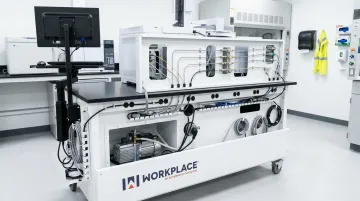
These benches are available in 9 standard configurations plus custom options, with compatibility across major GC-MS manufacturers including Thermo Fisher Scientific, Agilent, Shimadzu, Waters, Bruker, and PerkinElmer.
Workflow Layout and Reconfigurability
Sample prep areas, instrument benches, and data review stations should flow logically in sequence. Misaligned layouts increase handling steps, raise contamination risk, and wear analysts down over long shifts.
Workplace's modular design allows accessories to be added or removed as instrument configurations change — relevant when labs upgrade from single quadrupole to triple quadrupole systems or add new autosampler formats. Custom GC bench configurations ship from their Londonderry, NH facility, with Quick Ship options available in approximately 14 days and standard custom orders typically completing in 30-45 days.
Ergonomics for High-Throughput Workflows
Analysts running high-sample-volume GC-MS workflows spend hours at the bench — fatigue and repetitive strain become real productivity factors over extended batches.
The Direct Drive® height-adjustable workstation addresses this directly. Key specs for GC-MS environments:
- 14 inches of motorized vertical travel
- 500-lb static capacity, expandable to 750 lbs in three-leg configurations
- Synchronized leg adjustment for smooth transitions between sitting and standing
- Multi-user compatibility for labs with analysts of varying heights
Frequently Asked Questions
What does GC-MS stand for?
GC-MS stands for Gas Chromatography-Mass Spectrometry. It's a hyphenated analytical technique that separates compounds using gas chromatography and identifies them using a mass spectrometer, providing both quantitative and qualitative data from a single analysis run.
Are GC and GC-MS the same?
No. GC alone separates compounds and detects them using non-specific detectors like FID, which measures response but cannot confirm identity. GC-MS adds a mass spectrometer as the detector, enabling definitive compound identification through spectral library matching.
What is the difference between GC-MS and LC-MS?
GC-MS handles volatile, thermally stable organic compounds that can be vaporized and separated in a gas phase column. LC-MS is designed for non-volatile, thermally labile, polar, or high-molecular-weight compounds separated in liquid phase. Both use mass spectrometry for detection; the chromatographic front-end differs.
How accurate is a GC-MS drug test?
GC-MS is an accepted confirmatory method under HHS/SAMHSA Mandatory Guidelines for federal workplace drug testing, used to confirm positive immunoassay screens with high specificity. Confirmation laboratories must quantify drug concentrations within ±20% of reference values under federal proficiency testing requirements.
How much does a GC-MS cost?
GC-MS pricing varies widely by system type and configuration. Manufacturers including Agilent, Thermo Fisher, and Shimadzu route buyers to quote workflows rather than publishing list prices. Ongoing costs include carrier gas supply, column consumables, maintenance contracts, and spectral library software — the NIST library, for example, runs approximately $8,600 separately.
Is GC better than HPLC?
Neither is universally better — they serve different compound classes. GC-MS excels for volatile organic compounds and delivers spectral identification; HPLC is preferred for non-volatile, thermally sensitive, or high-molecular-weight analytes where GC requires derivatization or is simply impractical.