What are bespoke production workstations?
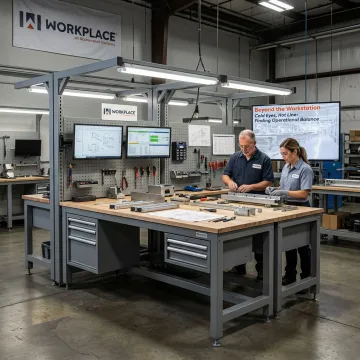
Bespoke production workstations are custom-engineered work areas built around a specific process, team, equipment footprint, and operating environment. Unlike standard benches, they can include tailored dimensions, ergonomic features, modular accessories, ESD-safe surfaces, chemical-resistant materials, vibration-dampening frames, storage, lighting, monitor mounts, and documentation support for compliance-driven programs.
What industries use bespoke production workstations?
These workstations are used by aerospace and defense teams, EV battery assembly operations, pharmaceutical and chemical labs, analytical laboratories, medical device manufacturers, R&D engineering groups, industrial manufacturers, quality control teams, service and repair departments, and training facilities. Each configuration can be adapted to match the workflow, equipment, safety requirements, and productivity goals of the application.
Can you design workstations for analytical instruments?
Yes. Workplace Modular Systems supports mass spectrometry and analytical lab workstation applications, including LC-MS benches, GC-MS benches, ICP-MS benches, and OEM instrument integration. Configurations can account for instrument footprint, weight, service access, vibration control, cable management, ergonomic use, and compatibility with manufacturers such as Waters, Thermo Fisher, Agilent, Shimadzu, Bruker, Sciex, and others.
How does the custom workstation design process work?
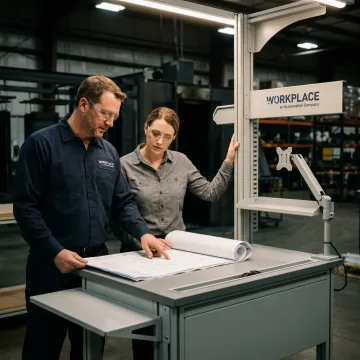
The process begins with a consultation to understand workflow, equipment, space constraints, load requirements, operator tasks, ergonomic needs, and future flexibility. A design specialist and in-house engineering team then develop configuration recommendations and engineered drawings. After review and approval, the workstation is manufactured, finished, delivered, and supported through installation or future reconfiguration.
Are the workstations modular and reconfigurable?
Yes. Workplace Modular Systems designs workstations to be modular, so accessories can be added, removed, or repositioned as requirements change. This helps teams adapt to new equipment, altered workflows, expanded staffing, automation, testing needs, or facility changes without replacing the entire workstation system, reducing downtime and supporting long-term operational flexibility.
What materials are used in custom production workstations?
Configurations may include 18-gauge furniture-grade steel tubing, welded steel frames, powder-coated components, chemical-resistant work surfaces, ESD-safe laminates, vibration-dampening frame designs, and application-specific accessories. Material selection depends on the environment, such as electronics assembly, pharmaceutical production, analytical testing, aerospace assembly, EV battery work, or general industrial manufacturing.
Can workstations support compliance documentation requirements?
Yes. Custom documentation packages can be developed for compliance-driven programs, including aerospace, defense, laboratory, and quality-focused environments. Depending on the project, documentation may support requirements tied to AS9100, MIL-STD-1472, SEFA 8, or ISO/IEC 17025 considerations, helping facility planners, engineers, and quality teams align workstation design with program expectations.
Do you offer consultation and engineered drawings?
Yes. Workplace Modular Systems provides free lab table and casework consultation, along with complimentary engineered drawings at no additional cost for qualifying projects. This helps teams visualize workstation layouts, confirm technical requirements, review accessory placement, assess fit for equipment, and make informed decisions before moving forward with manufacturing.