Introduction
Most cobot deployments that fail don't fail because of the robot. They fail because the surrounding workstation wasn't built to support it. The frame, mounting surface, cable management, and safety infrastructure all impact cobot performance, worker safety, and ROI — yet they're often treated as afterthoughts.
That workstation gap is growing more consequential as adoption accelerates. MarketsandMarkets projects the global cobot market will reach $3.38 billion by 2030, up from $1.42 billion in 2025 — an 18.9% CAGR driven by demand across assembly lines, quality control stations, packaging cells, and machine tending operations.
This article evaluates five manufacturers — Universal Robots, FANUC, ABB, Vention, and KUKA — on their ability to deliver complete, deployable cobot workstation solutions. The evaluation covers robot hardware, ecosystem strength, workstation integration capabilities, and demonstrated success helping manufacturers build production-ready automation cells.
Key Takeaways
- Cobot workstations combine collaborative robot arms with physical infrastructure: frames, mounts, cable routing, and safety systems
- The global cobot market will grow from USD 1.42 billion in 2025 to USD 3.38 billion by 2030 at 18.9% CAGR
- Top manufacturers: Universal Robots (39% market share), FANUC (CRX series), ABB (GoFa/SWIFTI), Vention (platform-agnostic design), KUKA (cleanroom and precision)
- Payload capacity now reaches 30 kg, but under-5 kg cobots still represent 57.5% of market value
- Workstation quality — vibration dampening, ergonomic layout, cable management — affects cobot performance as much as the robot arm itself
What Is a Cobot Workstation and Why Does It Matter in 2026?
A cobot workstation is a complete, deployment-ready workspace that pairs a collaborative robot arm with purpose-built physical infrastructure — work surface, mounting pedestals, safety barriers, and cable routing. Unlike a bare robot arm, the full workstation is engineered around a specific industrial task.
How Cobot Workstations Differ From Traditional Robot Cells
Traditional industrial robots require perimeter fencing and extensive safety interlocks. Collaborative robot workstations operate differently:
- No perimeter fencing required when configured under ISO/TS 15066
- Faster reconfiguration for high-mix production environments
- Smaller footprint compared to traditional robot cells
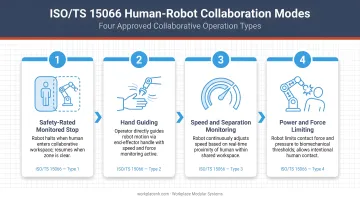
- Designed for human-robot collaboration through four modes defined by ISO/TS 15066: Safety-Rated Monitored Stop (SRMS), Hand Guiding (HGC), Speed and Separation Monitoring (SSM), and Power and Force Limiting (PFL)
Each mode enables a different level of human interaction — from full stop on approach to continuous side-by-side operation — while keeping workers within safety limits.
With flexible automation now a priority across assembly, quality control, packaging, and machine tending, the workstation infrastructure surrounding the cobot matters as much as the robot itself. That's where manufacturer selection becomes critical.
Top 5 Cobot Workstation Manufacturers for Industrial Automation (2026)
These five manufacturers deliver complete cobot workstation solutions—not just robot arms—evaluated on deployment readiness, ecosystem strength, application versatility, safety standards, and market track record.
Universal Robots
Founded in 2005 in Odense, Denmark, Universal Robots pioneered the commercial cobot market with its first UR5 model in 2008. Acquired by Teradyne in 2015 for $285 million, UR has since deployed over 75,000 cobots globally across 65 countries.
UR's strength lies in the UR+ ecosystem: a certified marketplace of mounting systems, fixture kits, cable management tools, and software integrations from 1,100+ partners. This lets manufacturers build complete cobot workstations without custom engineering.
Applications span assembly, palletizing, welding, and quality inspection with redeployment times under 30 minutes.
| Specification | Details |
|---|---|
| Key Models | UR3e, UR5e, UR10e, UR16e, UR20, UR30 (3–30 kg payload range) |
| Workstation Integration | UR+ certified accessories including mounting brackets, fixtures, safety I/O, vision systems; supports Modbus, Profinet, EtherNet/IP |
| Price Range (Robot Only) | Approximately $35,000–$63,000 (varies by model; UR20e listed at $62,990 from third-party distributors) |
Universal Robots holds approximately 39% of the global cobot market share — a lead built on ecosystem depth rather than robot specs alone, which is why most third-party workstation accessories are designed for UR first.
FANUC (CRX Series)
FANUC, headquartered in Japan and a factory automation leader since 1956, entered collaborative robotics with the CR series in 2015. The CRX platform followed in December 2019, built for environments that demand both human-robot collaboration and industrial-grade durability.
The CRX series targets automotive, aerospace, and electronics manufacturers that need performance in harsh or high-precision conditions. IP67-rated bodies on food-grade variants, drag-and-drop tablet programming, and deep integration with FANUC's CNC ecosystem are the differentiating features.
For manufacturers already running FANUC machine tools, the CRX series enables a unified automation architecture across the production floor.
| Specification | Details |
|---|---|
| Key Models | CRX-3iA, CRX-5iA, CRX-10iA, CRX-10iA/L, CRX-20iA/L, CRX-30iA (3–30 kg payload; reach up to 1,889 mm) |
| Workstation Integration | IP67-rated food-grade variants; integrates with FANUC CNC machines and ROBOGUIDE simulation software; tablet-based no-teach programming |
| Price Range (Robot Only) | Approximately $20,000–$45,000 for used units; new pricing available upon request from authorized distributors |
FANUC accounts for approximately 21% of the global cobot market, second only to Universal Robots.
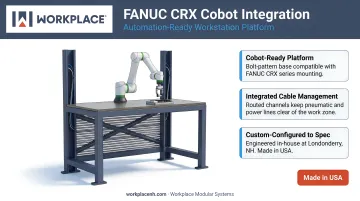
ABB (GoFa & SWIFTI)
ABB, formed in 1988 from the merger of ASEA and Brown Boveri, offers the GoFa (CRB 15000) and SWIFTI (CRB 1100) cobots as part of broader cobot cell and workstation solutions, backed by a global service and integration partner network.
ABB's workstation ecosystem is built for high-speed assembly and pick-and-place environments. The SWIFTI combines collaborative safety with industrial robot speeds exceeding 5 m/s TCP, while the GoFa supports intuitive hand-guided teaching. ABB's SafeMove2 safety software enables precise speed, position, and axis monitoring without physical guarding, reducing workstation footprint.
The GoFa family spans three payload variants — 5 kg, 10 kg, and 12 kg — with reaches from 0.95 m to 1.52 m. All are ISO Class 4 cleanroom rated, with IP67 protection on the 10 kg and 12 kg models.
| Specification | Details |
|---|---|
| Key Models | GoFa CRB 15000 (5 kg/0.95 m, 10 kg/1.52 m, 12 kg/1.27 m); SWIFTI CRB 1100 (4 kg, 580 mm reach) |
| Workstation Integration | SafeMove2 collaborative safety; compatible with ABB's OmniCore controller and RobotStudio simulation; vision system integration supported; ISO Class 4 cleanroom rated |
| Price Range (Robot Only) | Pricing available through authorized ABB distributors upon request |
Vention
Manufacturers that anticipate reconfigurations — or want the option to switch cobot brands — get the most from Vention's model.
KUKA (LBR iisy & LBR iiwa)
KUKA, a German robotics firm with deep roots in automotive and precision manufacturing, offers the LBR iiwa and LBR iisy as part of complete collaborative workstation solutions — targeting electronics, pharmaceutical production, and laboratory automation where force sensitivity and cleanroom compatibility are non-negotiable.
KUKA's workstations are distinguished by torque sensors on every joint, which enable force-guided assembly tasks that most cobots cannot handle. The LBR iiwa's seven axes support complex motion paths; the LBR iisy (six axes) trades some of that range for faster plug-and-play workstation setup.
KUKA also offers the widest cleanroom portfolio in this group: both the iiwa and iisy families include ISO 14644-1 Class 3 certified variants, which cuts validation costs in pharma, semiconductor, and medical device environments.
| Specification | Details |
|---|---|
| Key Models | LBR iiwa 7 R800 / 14 R820 (7–14 kg payload, 800–820 mm reach, 7 axes); LBR iisy (3–15 kg payload, 6 axes, cleanroom Class 3 variants available) |
| Workstation Integration | Cleanroom-compatible variants; joint torque sensors on all axes; KUKA Sunrise controller; supports EtherCAT for Industry 4.0 integration |
| Price Range (Robot Only) | LBR iiwa 14 R820 approximately $35,000 from third-party resellers; official pricing through authorized KUKA distributors |
How We Chose the Best Cobot Workstation Manufacturers
The Most Common Buyer Mistake
Manufacturers often evaluate cobot workstations based solely on payload capacity and reach specifications—while overlooking total system readiness. The physical workstation infrastructure, safety architecture, and integration ecosystem determine whether a cobot deployment succeeds or stalls.
Evaluation Criteria
We selected these five manufacturers based on:
- Deployment readiness and time-to-production – How quickly can a complete workstation go from concept to production?
- Ecosystem depth – Availability of certified accessories, software integrations, and partner solutions
- Safety certifications – Compliance with ISO 10218-1, ISO/TS 15066, and regional standards
- Application versatility – Range of industries and use cases supported
- Workstation modularity and reconfigurability – Ease of adapting to changing production needs
- Total cost of ownership – Robot price plus integration, training, and maintenance
Why Physical Workspace Quality Matters
A well-engineered cobot workstation—with ergonomic work surfaces, proper cable management, lighting, and modular mounting—directly affects throughput, worker safety, and the cobot's ability to perform consistently.
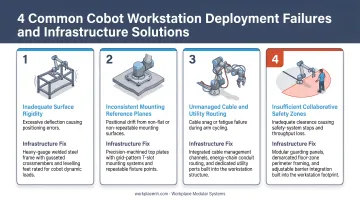
Common deployment failures trace back to inadequate workstation infrastructure:
- Vibration issues from weak mounting surfaces cause positioning errors
- Reach envelope failures from incorrect pedestal height waste floor space
- Cable management problems create safety hazards and downtime
- Poor ergonomics reduce operator efficiency in collaborative workflows
Getting this foundation right before deployment is what separates teams that hit production targets from those that spend months troubleshooting. Workplace Modular Systems, drawing on over 65 years of workstation manufacturing experience, builds specifically for these conditions. Their Collaborative Robotics Bench Platform uses vibration-dampening welded steel bases, UR-spec mounting patterns, integrated cable management, and task lighting—all validated through the UR+ certification pathway.
Conclusion
Choosing a cobot workstation manufacturer in 2026 means evaluating the full system—robot arm performance, workstation modularity, safety standards, and integration ecosystem—not just brand reputation or list price.
Before committing to a platform, assess your specific application needs:
- Payload requirements and duty cycle
- Environmental conditions (cleanroom, temperature, moisture)
- Reconfiguration frequency for product changeovers
- Workforce skill level and training capacity
- Total cost of ownership including integration, accessories, training, and maintenance
Once you've mapped those requirements, the workstation infrastructure becomes the next critical decision. The bench frame, cable routing, ergonomic layout, and modularity of the physical workspace determine how well any cobot system actually performs in practice. Workplace Modular Systems specializes in that physical layer — designing and manufacturing modular workstations built specifically to support automation environments across manufacturing, assembly, and quality control applications.
Ready to build a cobot-ready workspace? Contact Workplace Modular Systems at 800.258.9700 for a consultation.
Frequently Asked Questions
How much does a collaborative robot cost?
Cobot arms typically range from $25,000 to $63,000 depending on payload and brand (robot only, excluding workstation infrastructure). Full workstation system cost (including integration, end-effectors, safety systems, and accessories) can reach 2-3× the robot-arm price. Most manufacturers don't publish list prices; request quotes from authorized distributors.
Who is the largest manufacturer of cobots?
Universal Robots holds approximately 39% market share with over 75,000 cobots installed globally. FANUC accounts for approximately 21%, with ABB and KUKA also holding significant positions. The market is growing rapidly with new entrants increasing competition.
What is a cobot workstation and how does it differ from a standard cobot setup?
A cobot workstation is a complete, deployment-ready system combining the robot arm with physical infrastructure—work surface, mounting pedestals, safety systems, and cable management. A standard cobot setup may refer to the robot arm alone without the surrounding environment engineered for production use.
What safety certifications should a cobot workstation meet before deployment?
Cobot workstations must comply with ISO 10218-1 (robot safety), ISO/TS 15066 (collaborative operation), and applicable OSHA or regional standards. Certified safety features like force-limiting joints and speed monitoring are required for cage-free human-robot collaboration. OSHA requires a documented task-based risk assessment before commissioning.
Can cobot workstations be reconfigured for different tasks or production lines?
Yes, modularity is a key advantage. Both the robot arm (reprogrammable in minutes with modern interfaces) and the physical workstation structure (if built on modular framing systems) can be adapted as production needs change. This makes cobots a flexible investment for high-mix manufacturing environments.
What is the typical ROI timeline for a cobot workstation investment?
ROI typically ranges from 6 to 18 months depending on application, shift utilization, and integration complexity. Universal Robots cited an average payback of 195 days in 2015. High-volume repetitive tasks like palletizing and machine tending deliver the fastest payback; single-shift or complex integrations push timelines closer to 18 months.